
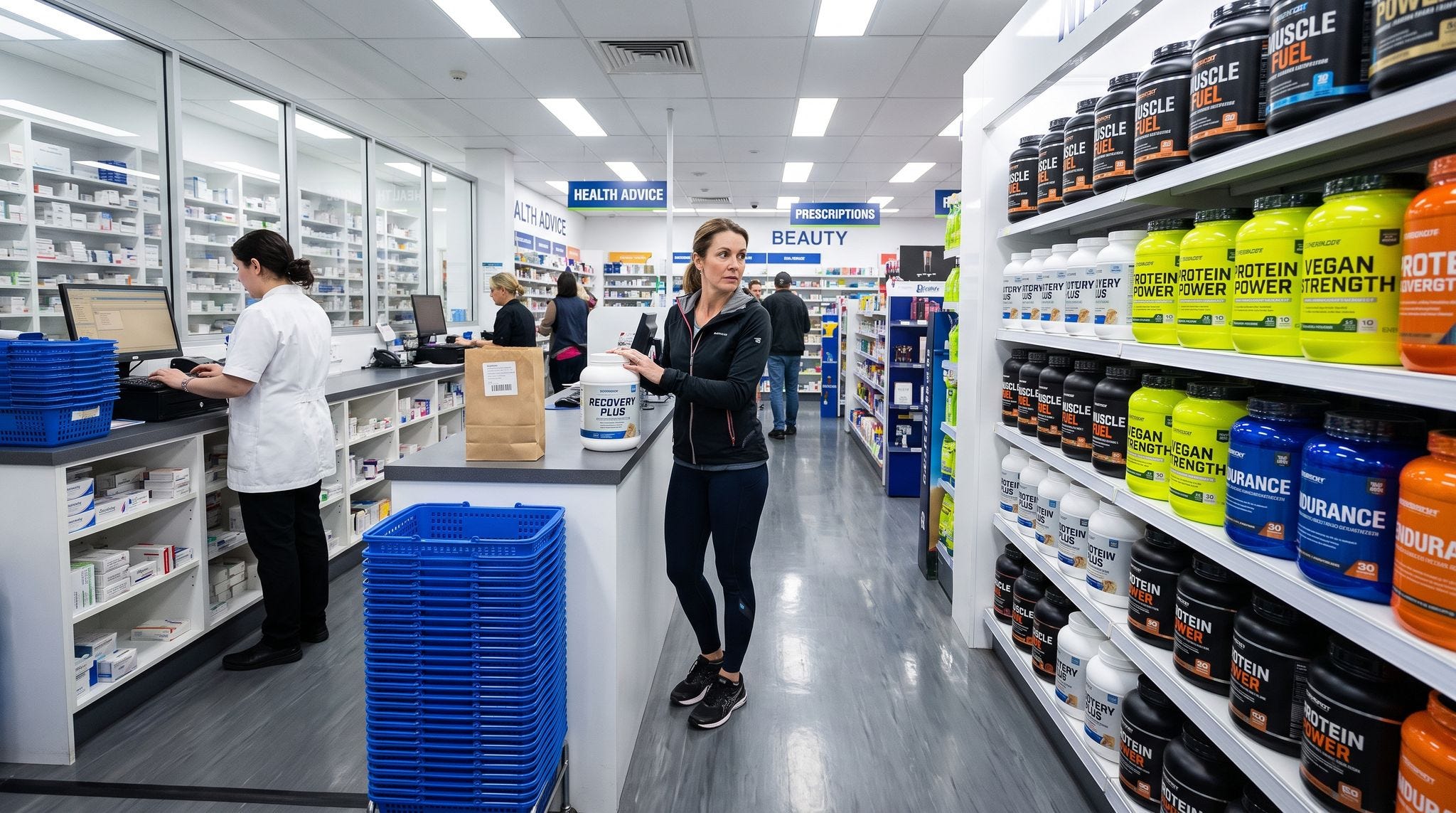
Sometime in the last 18 months, every cardiologist, longevity podcaster, fitness coach, and biohacker in your feed started talking about the same supplement at the same time. The compound has been studied in controlled human trials since 1992. The commercial supply chain has existed since 1993. The peer-reviewed evidence base on muscle physiology was substantially complete by the early 2000s. Hundreds of papers had been published, dozens of them in major journals, before the vast majority of the people now telling you about it had finished high school. None of that is what triggered the wave. Something else did.
The supplement is creatine. The point is not the supplement. The point is the timing.
Creatine works. The evidence base is genuine. The 2024 Gordji-Nejad study at Forschungszentrum Jülich, published in Scientific Reports, demonstrated measurable cognitive benefit under sleep deprivation. The 2025 follow-up confirmed the effect at lower doses. The 30-year corpus on muscle saturation, ergogenic effect, and ageing-related benefit is one of the most replicated bodies of nutritional research in existence. The reason a senior operator should consider it is not propaganda. It is evidence.
But that is not the question worth asking.
The question worth asking is why every channel into that operator's attention started selling them on it simultaneously, across the same six-month window, after three decades of public availability. The question is what produced the simultaneity. The question is cui bono. To whose benefit. It runs in slow motion across the calendar rather than the news cycle, but it runs.
The 36-year cultivation gap
The 1992 paper that opened the modern creatine literature was Harris, Söderlund, and Hultman in Clinical Science. Roger Harris had transitioned to equine research in 1983 and returned to human work after observing the compound's effects on racehorses. The 1992 paper was published in the same year Linford Christie won 100-metre gold and Sally Gunnell won 400-metre hurdles gold at the Barcelona Olympics, both later acknowledged as creatine users. The first commercial powder reached the consumer market in 1993.
By 1995, the case was made. By 2000, the evidence on safety, dosing, muscle saturation, and performance benefit was substantially settled. By 2005, the cognitive and neuroprotective research streams had opened and were producing replicable results. By 2015, creatine was the most studied ergogenic aid in the history of sports science.
For most of that period, it sat on the shelf at supplement retailers, used primarily by bodybuilders and a thin layer of clinical researchers. The general population did not take it. Their doctors did not recommend it. The wellness industry, when it noticed creatine at all, treated it as a niche product for serious lifters.
Then, somewhere between 2022 and 2024, the wave arrived. The US market grew an estimated 87 per cent in a single span. Industry projections now place the global market on a trajectory from roughly USD 1.1 billion in 2024 to between USD 8 billion and USD 10 billion by 2033, with compound annual growth rates of 25 to 29 per cent. Influencer channels saturated the topic across every platform simultaneously. Cardiologists with seven-figure podcast deals started recommending it. Ageing-related cognitive concern, the dominant fear of the affluent midlife demographic, was abruptly identified as a problem that this 30-year-old supplement could solve.
32 years between the Harris paper and the wave. Three decades of evidence sitting in plain sight, ignored by the channels that have now adopted it as gospel. The question is not whether the science changed. It did not. The question is what changed that allowed the same evidence to suddenly become marketable at scale.
Where the inquiry started
The official story is that Roger Harris was a curious researcher who pursued a hunch about equine performance and stumbled onto human application. That story is not false. It is incomplete.
Soviet and East German sports programs were rumoured to be using creatine through the 1970s and 1980s. The rumour was tracked by Western sports science and intelligence services, both of which were intensely interested in any compound the Eastern Bloc was deploying to dominate Olympic competition. Harris's transition into equine work in 1983 happened inside a horse-racing industry that has historically functioned as a more permissive testbed for performance compounds than human competition. The equine route was not random. It was a known back channel. By the time the 1992 Barcelona Games produced gold-medal endorsements and a Times of London article naming creatine, the commercial framework was ready. The compound, the supply, the research credibility, and the public moment all arrived in the same year. That is not happenstance. It is coincidence in the proper sense of the word. To co-incide is to fall together, to occupy the same point. When the research, the supply chain, the gold medal, and the press coverage all land in the same twelve months, they have not converged by accident. They have converged because something below the surface connects them. The corruption of the word coincidence into a synonym for randomness is itself part of the apparatus this article is describing. First they take the words, then they take the meaning that lets you see what the word was for.
Research does not generate spontaneously. Someone funds the study. Someone sets the question. Someone decides which compound is investigated when. The 1992 Harris paper was not the moment creatine was discovered. It was the moment a previously controlled reserve was released into the commercial framework that had been built to receive it.
The pattern is worth holding in mind. Reserve known to state-level actors first. Reserve moved through a permissive commercial vehicle, in this case equine performance research. Reserve released to the public market at the moment of maximum visibility, a global sporting event. Reserve commercialised through a supply chain controlled by capital that already owns the rest of the consumer wellness vertical.
That sequence is not specific to creatine. It is the operating template.
The ownership chain that destroys the conspiracy frame
This is the part that converts pattern recognition from speculation into receipt-backed analysis.
The largest health and supplement retailer in the United States is GNC. GNC operates more than 4,000 stores including locations inside US military installations such as Andrews Air Force Base, Fort Bragg, and Patrick Space Force Base. In 2020, after a bankruptcy filing, GNC was acquired in full by Harbin Pharmaceutical Group, China's largest pharmaceutical company. Harbin is majority-owned by Harbin SASAC, a Chinese state-owned investment vehicle holding 38.25 per cent, with CITIC Capital, an arm of the Chinese state's foreign-investment apparatus, holding 19.1 per cent. The acquisition was reviewed and cleared by the Committee on Foreign Investment in the United States.
A Chinese state-controlled pharmaceutical company owns the largest American supplement retailer. The pharmacy and the supplement aisle, which most consumers experience as separate categories, are owned at the corporate level by the same entity. That entity is itself a foreign-state holding.
Glanbia, the Irish dairy and nutrition group, runs Glanbia Nutritionals, which supplies excipients to pharmaceutical manufacturers, alongside Glanbia Performance Nutrition, which owns Optimum Nutrition, BSN, and several other major sports nutrition brands. The pharmaceutical excipient and the post-workout protein come out of the same corporate structure. The Hut Group, which owns Myprotein, has been recycled through private equity ownership and public market vehicles for years. AlzChem, the German speciality chemicals firm that produces Creapure, the only credible high-purity creatine raw ingredient, supplies multiple industries including pharmaceutical intermediates.
This is not conspiracy. It is corporate filings. The structural reality is that the pharmaceutical industry, the supplement industry, the food fortification industry, the medical excipient industry, and the consumer wellness retail industry all operate inside a consolidated capital structure with substantial cross-ownership. The image of pharma as one industry and supplements as a separate, even oppositional, industry survives only because nobody bothers to follow the equity upstream.
When the same capital structure owns both the disease management vertical and the wellness vertical, the two are not competitors. They are tiers of the same extraction model. The pharmaceutical sells the prescription for the chronic condition. The supplement sells the optimisation that the affluent customer reaches for once they realise the prescription is not enough. The customer pays into the same till twice, in two different aisles, under two different brand promises, with two different aesthetic worlds, owned by the same equity.
The macro engineering that produced the customer
This is where the slow-motion cui bono lands.
The customer who buys creatine in 2025 is not a randomly emerging market segment. The customer was engineered, across decades, by the same capital structure that now sells them the remediation.
The engineering happened across four substrates. Each is documented. None is theoretical.
Work and household. Between 1948 and 1973, US productivity and worker compensation grew in lockstep. After 1973, the relationship broke. From 1979 to 2025, US productivity rose by approximately 90 per cent while hourly compensation rose by approximately 33 per cent. The gap is not a forecasting error. It is value transferred from labour to capital across 46 years. The household that could maintain itself on one earner in 1965 could not by 1995. Two earners became mandatory. The unpaid labour that previously held families together, cooking real food, raising children directly, sustaining community, transmitting trade and judgement across generations, was outsourced to institutions designed to deliver those functions at scale and at margin.
Housing. In Australia, where I write from on the Gold Coast, the Sydney median house price moved from approximately five times average annual earnings in 1970 to over 20 times in 2024. The national median house price to gross disposable household income ratio moved from 4.9x in 2002 to 8.6x in 2024. By 2026, a single Australian on the average full-time wage will be unable to purchase a typical house in any capital city. This is not a market outcome. It is the result of specific policy decisions on monetary expansion, mortgage securitisation, tax treatment of investment property, and foreign capital inflow. Housing was converted from a shelter category for people into an asset class for capital.
Food, water, air. The industrial seed oils that displaced animal fats. The high-fructose corn syrup that colonised the processed food supply. The ultra-processed products that now constitute more than half of the average Western diet by calorie. The glyphosate sprayed on wheat at desiccation. The PFAS contamination of municipal water supplies. The fluoride added to drinking water without consent. The atmospheric particulates introduced by combustion, industrial agriculture, and the geoengineering and weather modification programs that have operated openly for decades. The three substrates the human body requires to function, food, water, air, have all been altered by the same capital structure across the same decades, with measurable downstream effects on metabolic health, cognitive function, hormonal balance, and longevity. Bill Gates' investment portfolio, to take one publicly verifiable example, simultaneously funds laboratory-produced cocoa, lab-grown meat, novel modified seed, and the pharmaceutical interventions sold to people whose bodies are degrading from eating what the rest of the portfolio has put into the supply chain.
The pharmaceutical management of the consequences. SSRIs for the depression that follows atomisation. Stimulants for the children whose attention shattered under screens and absent parents. Statins for the cardiovascular damage caused by the food. Opioids for the chronic pain caused by the work. Sleep medication for the insomnia caused by the cortisol. Ozempic for the metabolic dysfunction caused by everything above. At every layer of the engineered damage, the same capital structure sells the pharmaceutical management of the consequence.
That is the customer creatine arrives to serve in 2025. Sleep-deprived because workload demands it and stress prevents recovery. Cognitively degraded because food, screens, cortisol, and environmental load have eroded baseline function. Affluent enough to afford a remediation. Conditioned by three decades of wellness culture to look for the supplement that solves it. Aware enough to know something is wrong but too embedded in the system to opt out.
The customer was farmed.
Three categories, one defence
Anyone reading this who has been trained by mainstream commentary will have already reached, somewhere in the last two pages, for the phrase "conspiracy theory." The phrase is not a description. It is a defence mechanism the system has trained into its audience to short-circuit pattern recognition before pattern recognition becomes operational.
There are actually three categories here, not two, and the conflation of them is itself a piece of system architecture worth naming.
The first category is conspiracy theory in the genuine sense. Intent assigned without evidence. Causal chains stitched together from happenstance. Patterns asserted where none exist. This category is real and it produces genuine error. Some of it is paranoid. Some of it is opportunistic. Some of it is harmless speculation. The system uses this category as a holding pen for everything else.
The second category is receipts-backed pattern recognition. The capital structure is followed to the point where intent becomes structurally guaranteed. Ownership chains are documented. Funding flows are traced. Filings, contracts, and balance sheets carry the argument. This is what most of the present article has been doing, and the GNC and Harbin chain is the type specimen.
The third category is the one the system most aggressively conflates with the first. Call it anticipatory pattern recognition. The reader sees the structural shape before the documentary record confirms it. They are reading topology, motive, capital flow, behavioural tell, and historical rhyme rather than waiting for a leaked memo to validate what the topology already showed. This is the faculty that produced people who saw the Iraq war pretext for what it was before the documents came out, the Epstein network for what it was before the testimony came out, the COVID origin question for what it was before the lab-leak hypothesis was officially permitted, the financial product fragility of 2007 before the collapse of 2008, and any number of other reads that were dismissed in real time and confirmed later. Anticipatory pattern recognition lives in advance of the receipts. That is its defining property. It is right often enough that the system has had to invest heavily in delegitimising the faculty itself, because a population that practices it cannot be sold the official narrative on the official timeline.
The system's most effective defence is to fold the third category into the first, so that anyone reading structure ahead of the document trail is filed alongside the genuinely paranoid and dismissed in the same gesture. This article is not engaged in category one. Most of it is engaged in category two. Some of it, particularly the read on what is being engineered next, is engaged in category three. The categories are different activities. The conflation is the manoeuvre.
I am not telling you that a small group of people met in a room in 1989 and decided to engineer a market for creatine to begin in 2024. I am telling you that the ownership of the supplement retail channel, the pharmaceutical channel, the food industrial channel, and the agricultural input channel sits inside a consolidated capital structure that did not require anyone to meet in a room. The structure produces the outcome the way a watershed produces a river. No conspiracy. Just gradient. Water runs downhill. Capital runs toward maximum extraction. When the same capital sits behind the question, the research, the supply chain, the retail channel, the marketing apparatus, and the fact-checking infrastructure that adjudicates what claims are permitted, the outcome is structurally guaranteed without anyone having to coordinate it.
What this has to do with leadership
Pattern recognition is the senior operator's structural edge. It applies to creatine. It applied to the financial products that were marketed as safe between 2003 and 2007. It applied to the institutional consensus around mortgage-backed securities, the consensus around the pre-2008 derivatives architecture, the consensus around emerging-market sovereign debt at multiple points across the last four decades, and the consensus around every category of asset that was sold as a sure thing in the 18 months before it collapsed.
It applies right now to the institutional consensus around generative artificial intelligence. The same operators who saw the dot-com top, who saw the subprime build-up, who saw the SPAC wave for what it was, are already reading the AI cycle as a release pattern rather than a discovery. The technology is real. The science is genuine. The capital structure routing investment toward it is the same structure that routes investment toward every prior commercialisation wave. The question is not whether the technology works. The question is who positioned themselves upstream of the wave and what they are extracting downstream of it.
The senior operator's edge is the willingness to ask that question while their peers are reading the press releases. It is the discipline to follow ownership chains rather than narratives. It is the refusal to accept the framing that the current consensus is somehow different from the last seven consensuses.
This is a transferable skill. It is not a wellness tip. It applies across categories, across decades, across geographies. The leader who reads release cycles in real time is not smarter than their peers. They have trained their attention on a layer of the system most people never look at.
The cultivated audience
There is a category that consumer marketing professionals use without irony in their internal documents. They call it the cultivated audience. The cultivated audience is the customer base whose receptivity to a future product has been pre-built through years of content, conditioning, and adjacency. The cultivated audience does not know it is the cultivated audience. That is the point of the cultivation. The commodity is the receptivity itself.
The wellness industry has been cultivating its audience since the early 1990s, through the same decades in which the household, the food supply, the medical system, and the asset markets were being engineered into their current state. By the time creatine arrived as the must-have supplement in 2024, the audience was ready in the way that crops are ready at harvest. The work of receptivity construction had been done. The product simply walked onto a field that had been prepared.
The leader who recognises themselves as the cultivated audience has done the most important work of the recognition. The audience that knows it is the audience is no longer the harvest. The moment a senior operator stops accepting that the supplement aisle, the wellness clinic, the longevity protocol, and the next manufactured must-have are the answer, the system loses its grip on them. Not because they have opted out of modern life. Because they have opted out of the role the system requires them to play.
Source upstream
I am not going to tell you to take creatine. I am also not going to tell you not to. The substance question is downstream of the structural question, and the structural question is what you do once you have read the pattern.
What the operator does, in practice, looks like this. Source upstream of the corrupted channel wherever possible. Not for purity. For dependency. Every step closer to where your food, water, and information are produced is a step further from the channel that sells you the remediation. Reduce the dependencies that make you the customer. The customer has already lost. The leader recognises which of their needs the system has architected itself to supply and asks how many of those needs can be met outside the architecture. Build what cannot be sold back to you. Health that comes from sleep, sunlight, real movement, real food, and human connection cannot be commercialised the same way that synthetic optimisation can. The system has spent decades training people to distrust those inputs because they do not produce margin. Trust them precisely because they do not produce margin.
And transmit the recognition. The pattern does not break when one person sees it. It breaks when the seeing is transmitted to the next generation rather than left for them to rediscover from inside the noise. The senior operator who reads release cycles and sees the engineered customer has done useful work for themselves. The senior operator who transmits what they have seen to their children, their team, their network, is operating at the only layer where the pattern can actually be broken. Private recognition without transmission is just private optimisation. Useful for you. Worthless for the system.
The system does not require you to believe it. It requires you to keep paying for the remediation of the damage it caused. The moment you stop being the customer of the cure for the disease it manufactured, you become a problem it cannot solve.
Be that problem.

Paul Lange advises owners, executives, and boards on the decisions that define commercial outcomes and organisational character, and on what a working board actually contributes. He has spent close to four decades across finance, technology, hospitality, professional services, and operating roles, in Europe, Asia, the Middle East, and Australia, on both sides of the table, with private equity and venture capital one part of it, and has taken five of his own companies through to exit. He is the creator of the Total QX™ and TILE Theory™ frameworks, and the author of The 20% Leader, Mis(très)s Entrepreneur Manifesto, Evolve or Be Remembered, and The Inheritance Manifesto. He runs his advisory practice, Manolutions, from the Gold Coast, Queensland. He writes Conviction because leadership without accountability is just theatre.