
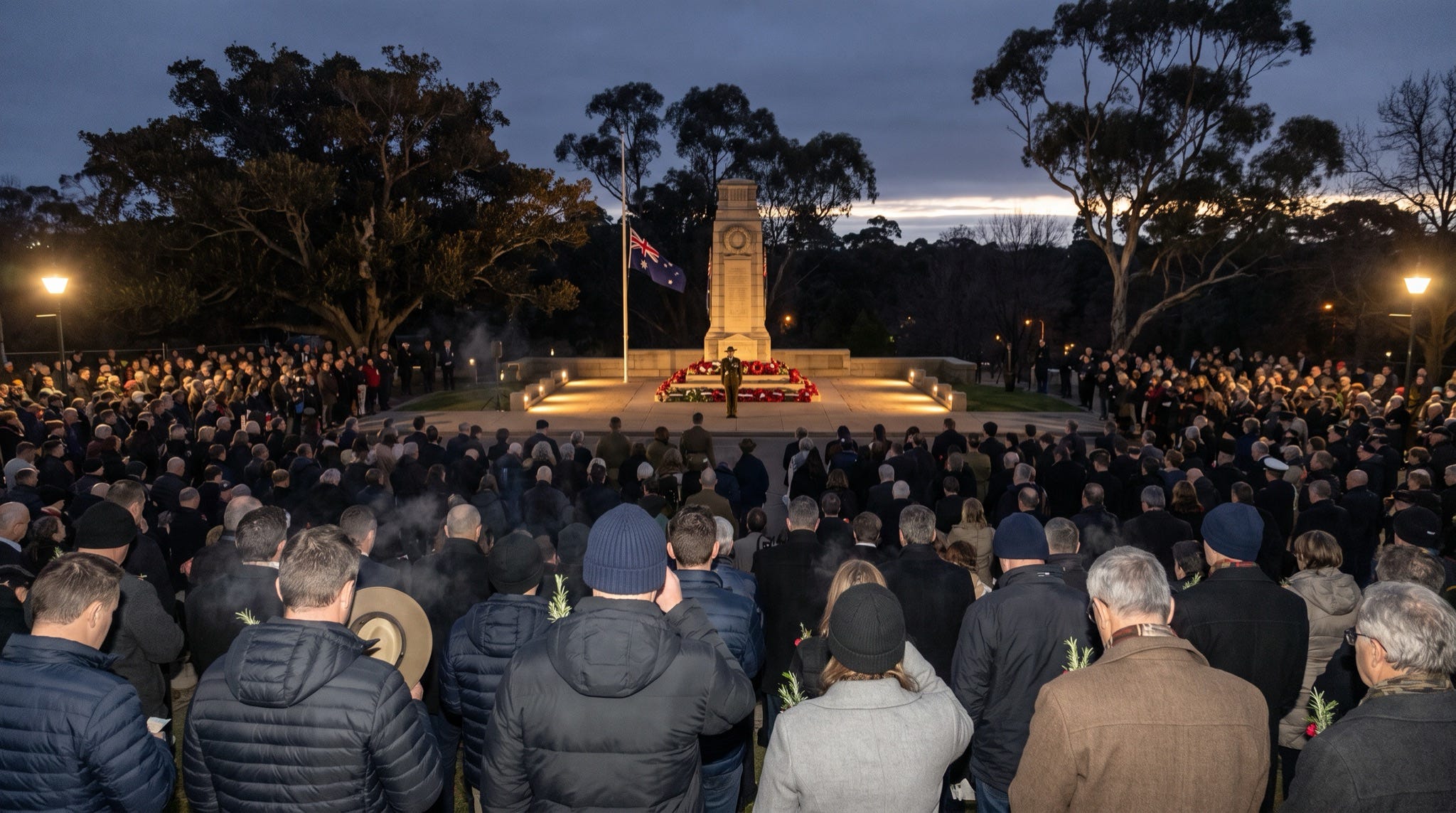
Within the living memory of every adult in Saturday's ANZAC Day crowds, the public business of this country was conducted without a Welcome to Country. There was no ceremony at the start of the football. None at the start of board meetings. None at the start of parliamentary openings. None at the start of the dawn service.
That was not 200 years ago. That was 30, in many places less. The modern public-event Welcome to Country, in the form Australians now recognise, was popularised in the late 1970s. Its expansion into nearly every institutional setting is largely a phenomenon of the last 15 to 20 years.
What did not exist, then existed in a few places, then was expected, then was apparently mandatory, then was allegedly untouchable. Inside one lifetime. That is the speed of the arc.
The arc was sold under a label. Evolution. Progress. Maturity. A country growing up. Anyone who questioned the speed or the substance of it could be dismissed as backward, regressive, or stuck in the past. That framing was the point. Demoralisation that announces itself as demoralisation meets resistance. Demoralisation wrapped in the language of progress meets applause.
On Saturday morning, in four cities, thousands of Australians decided the arc had reached its limit. At dawn services in Sydney, Melbourne, Perth, and Adelaide, booing interrupted the Welcome to Country and Acknowledgement of Country segments of the official program. A 24-year-old man was arrested in Sydney for nuisance. Police issued 14 move-on notices in Perth. Politicians and military leaders have spent the weekend condemning the booing.
The mainstream framing has predictably narrowed the entire incident to racism and right-wing extremism. That framing is convenient, because it spares the institutions the harder question of why the booing happened in the first place.
What almost nobody has said, and what this piece is about, is that the booing was not the aberration. The booing was the response to one. The aberration is what was being booed.
The pattern has a name.
It is demoralisation. The slow, deliberate hollowing of shared meaning until a population can be shown evidence of its own decline and not be moved to act on it. The longest and most invisible stage of national subversion, mapped most clearly by the KGB defector Yuri Bezmenov in the 1980s, and applicable, line for line, to what has been done to this country across the last 40 years.
Demoralisation does not announce itself. It accumulates. By the time anyone notices, the targets are no longer recognisable as the things they once were. Sacred markers are renegotiated, retitled, or quietly walked off the calendar. National character gets retrained to apologise for itself. Solemn occasions become stages for ritual the public did not ask for and never voted on.
ANZAC Day is one of the few sacred markers left that has not been broken on this anvil. It has held, across decades and political seasons, because the public has refused to let it go. That is what was being defended at four in the morning on Saturday, in four cities, by thousands of people who did not coordinate with each other and had nothing in common except a refusal to watch this one fall too.
How it got to the dawn service.
A Welcome to Country, in its original form, was a cultural greeting between aboriginal tribes, performed by elders for visitors entering land another tribe had settled. Specific. Bounded. Meaningful in context.
What it has become, across Australian institutional life, is a ritual pasted onto the front of nearly every event regardless of context. The expansion was an institutional decision, made by default, extended into spaces it was never designed for. Anyone who lived through the 1970s, 1980s, or even much of the 1990s remembers public life conducted entirely without it. The notion that it now belongs everywhere is itself a piece of demoralisation. It rewrites the past by acting as though the present has always been the present.
The drift came at a cost no one has ever totalled. The visible tip, prised out under FOI, is $452,953 across federal departments alone in just two financial years, 2022-23 and 2023-24. The Department of Prime Minister and Cabinet ran 33 of these ceremonies in that window at an average of $1,266 each. Single ceremonies have run as high as $6,600. Land councils set the fees.
The federal figure is the visible part. It excludes six state governments, two territories, 537 local councils, public broadcasters, universities, sporting codes, statutory bodies, government corporations, and the corporate sector that passes the cost through to its customers. It excludes the institutional staff time absorbed in arranging each one. And it covers two years out of more than four decades since the practice was first popularised in the late 1970s. The Coalition's own shadow minister could only describe the broader figure as "a multi-million-dollar industry," because nobody is required to total it.
That uncountability is not incidental. A cost no one totals is a cost no one can be held accountable for. A practice spread across thousands of separate decision-makers, none of whom decided to start it and none of whom answers for continuing it, is the operational definition of institutional capture.
This is not a story about aboriginal Australians. It is a story about what happens when institutions decide, without ever asking, that the country needs a new identity. The monetisation is one symptom. The lockstep adoption across public bodies, corporates, schools, and sporting codes is another. The casual rewriting of the past, conducted as though this ritual has always been there, is a third. Underneath all of it sits a substitution that was never put to the public: replacing a national identity built on shared sacrifice with one built on race-categorised grievance. The single time the substitution was put to a direct vote, in 2023, the public said no. The institutions kept going anyway. That is what demoralisation looks like in operation. Gradual. Procedural. Coordinated without ever being decided. Beyond the reach of any single accountable decision-maker, which is precisely why it works.
The 2023 signal was ignored.
In October 2023, the Voice referendum was rejected by 60 per cent of Australians. Every state except the ACT voted no. That was a clear democratic message. Not against aboriginal Australians, but against the constitutional embedding of race-based political structures.
The institutional response was to keep going as before. The rituals the referendum result might have prompted leaders to review were instead doubled down on. That is not respect for democracy. That is a choice to treat a clear vote as something the public did not really mean.
When you ignore a vote, the public eventually finds another way to communicate. Saturday was that other way.
The Cenotaph is the limit.
ANZAC Day is, at its core, a day of grief. It commemorates the dead. The men and women who did not come home. The families who carried it for the rest of their lives. It is the closest thing this country has to a national church, and it survives because the public has been willing to defend it where they have stopped defending other things.
The institutions that pasted contested political ritual onto the dawn service made a quiet calculation about how far the demoralisation could be extended. They were wrong. The Cenotaph is the line. The public has now made that clear in the only language the institutions had left them.
Trajectory.
Last year the disruption was scattered and easy to file under fringe. This year it was four cities, broader, louder, and harder to dismiss. Next year it will be louder again unless something changes.
What changes it is not enforcement. It is leadership. Real leadership would have asked, 10 years ago, where this ritual belongs and where it does not. Real leadership would have set guardrails on the monetisation before it became an industry. Real leadership would have read the 2023 referendum result honestly. Real leadership would have held the line on what ANZAC Day is for.
None of that happened. So the question got answered by the public, on the only ground left where the public still has a vote that cannot be ignored.
The booing was not disrespect. It was defence. Of one of the few sacred things this country still has, on the morning the institutions came for it.
That is not a failure of the public. That is a failure of leadership.

Paul Lange advises owners, executives, and boards on the decisions that define commercial outcomes and organisational character, and on what a working board actually contributes. He has spent close to four decades across finance, technology, hospitality, professional services, and operating roles, in Europe, Asia, the Middle East, and Australia, on both sides of the table, with private equity and venture capital one part of it, and has taken five of his own companies through to exit. He is the creator of the Total QX™ and TILE Theory™ frameworks, and the author of The 20% Leader, Mis(très)s Entrepreneur Manifesto, Evolve or Be Remembered, and The Inheritance Manifesto. He runs his advisory practice, Manolutions, from the Gold Coast, Queensland. He writes Conviction because leadership without accountability is just theatre.