
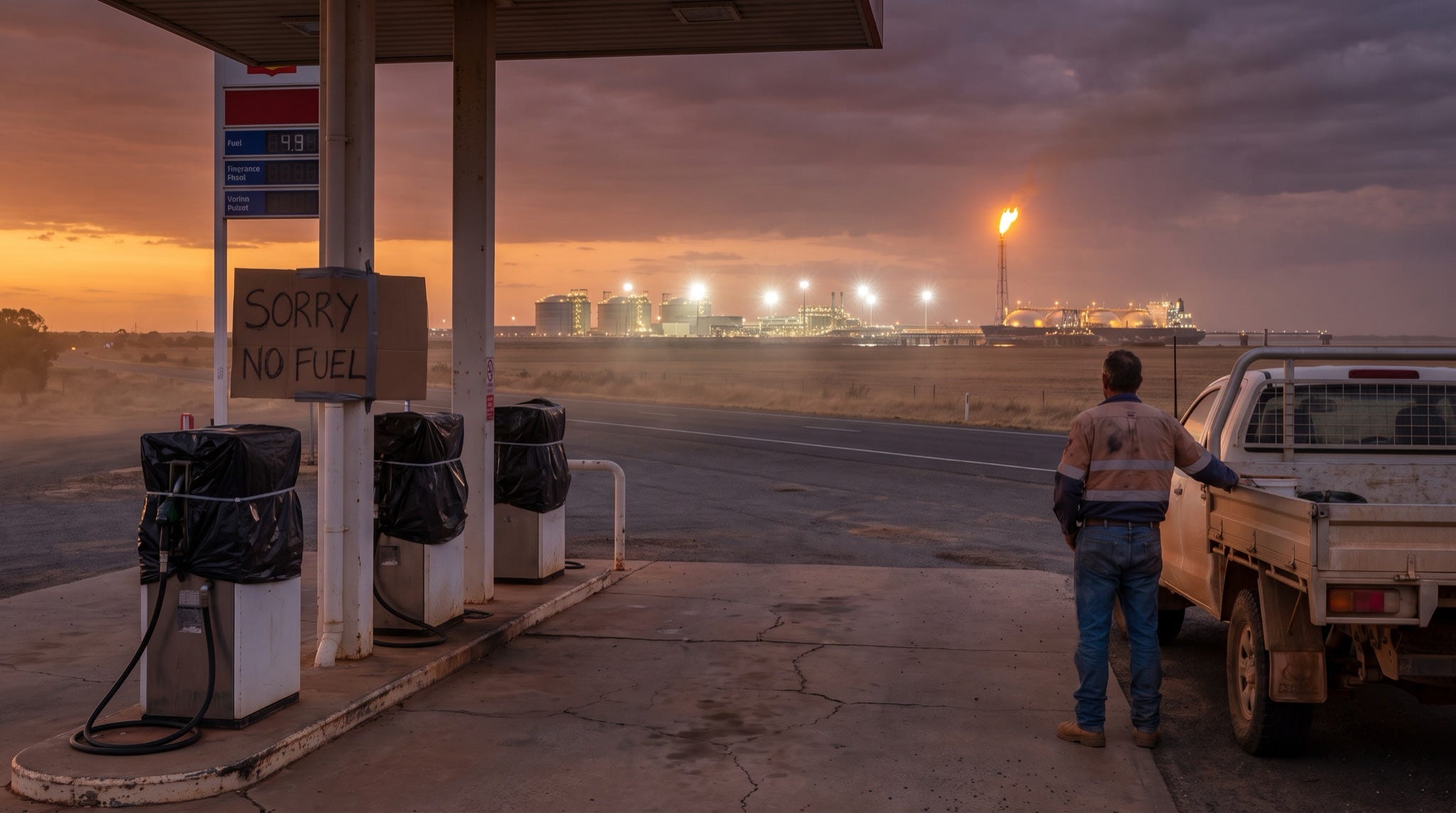
The Middle East is on fire. The Strait of Hormuz is effectively closed. Global energy markets are in freefall. And Australia — the world's second-largest LNG exporter — is rationing petrol at regional service stations and sitting on 26 days of diesel reserves.
Let that land for a moment.
We export energy to the world. We are sitting on some of the most significant gas and oil reserves on the planet. And right now, in the middle of the largest energy supply disruption in recorded history, we cannot guarantee our own fuel supply.
This is not a market failure. It is not an act of God. It is not bad luck.
This is the direct consequence of decades of catastrophic political failure — delivered faithfully, across generations, by both sides of Australia's political uni-party.

What Is Happening Right Now
The war between the US-Israel coalition and Iran began on 28 February 2026. Within days, it became an energy war.
Iran attacked Qatar's Ras Laffan complex — the world's largest LNG production facility, responsible for 20 per cent of global LNG supply. It fired missiles and launched drones on a Saudi Arabian oil refinery and on gas units in Kuwait and the UAE. Israel bombed Iran's South Pars gas field — the world's largest natural gas reserve. The US obliterated Iran's Kharg Island military infrastructure, which handles 90 per cent of Iran's oil exports.
The Strait of Hormuz — through which 20 per cent of the world's traded petroleum normally flows — has effectively shut down to commercial shipping. The International Energy Agency has described it plainly: this is the largest oil supply disruption in the history of the global energy market. Brent crude has surged above $114 a barrel. European gas prices have doubled since the war started. Global LNG supply has shrunk by nearly a fifth.
The IEA has triggered the largest emergency reserve release in history — 400 million barrels — and analysts are warning it may not be enough if the Strait stays closed.
The world is in an energy crisis. And Australia walked straight into it, blindfolded, with its hands tied behind its back — because its politicians told it to.
The Numbers That Indict a Political Class
Here are the facts. Not opinions. Facts.
Australia imports over 90 per cent of its refined oil products — diesel, petrol, aviation fuel. Our largest direct supplier is Singapore, but those supply chains trace back directly through the Gulf.
We hold approximately 26 days of diesel reserves and 29 days of petrol. The International Energy Agency's minimum standard for member nations is 90 days. We meet roughly a third of that benchmark.
In 2005, Australia had eight operating oil refineries. Today, two remain. The Ampol Lytton refinery in Brisbane and Viva Energy's Geelong refinery together supply less than 20 per cent of our liquid fuel demand.
Approximately 83 per cent of Australia's maritime imports and around 90 per cent of our exports move through the Indonesian straits — Malacca, Lombok and Sunda. The closure of Hormuz is not even our first layer of vulnerability. It is upstream of an already perilous supply chain.
Our strategic fuel reserves were effectively offshored. Successive governments, in their infinite wisdom, decided it was acceptable to store Australia's emergency fuel supplies overseas. Actual overseas. Not in Australia.
We are an island continent. A massive one. And we designed an energy security policy that requires importing refined fuel across contested maritime routes, with less than a month of reserves, and almost no domestic refining capacity left.
Whoever greenlit that should never be allowed near public office again. Except that in Australia, they keep getting re-elected.
The Great Australian Energy Paradox
Here is the part that should genuinely enrage every Australian.
We are the world's second-largest exporter of liquefied natural gas. We sit on some of the most significant untapped hydrocarbon reserves on Earth. The Beetaloo Sub-basin in the Northern Territory alone holds more than 500 trillion cubic feet of discovered and prospective gas resources — comparable to the Marcellus Shale in the United States, one of the most productive gas plays in the world.
Bass Strait has produced over 5 billion barrels of oil and more than 11 trillion cubic feet of pipeline gas since 1969. The North West Shelf. The Carnarvon Basin. The Cooper Basin. The Gippsland Basin. The Narrabri coal seam gas field in NSW, with enough gas to supply southern markets for years.
We have the resources. We have always had the resources.
What we have not had is the political courage to use them.
Instead, we have spent decades systematically dismantling, blocking, delaying, and abandoning the infrastructure that would make this country energy sovereign.
Bass Strait is now in managed decline and active decommissioning — over $3 billion already spent plugging and abandoning hundreds of wells. The Narrabri project, a $3.6 billion Santos development that could supply up to half of NSW's gas needs, has been strangled by legal challenges, regulatory delays, community opposition campaigns, and political cowardice for years. The Beetaloo Basin — despite finally showing first gas expected in late 2026 — has been subjected to moratoria, inquiries, re-inquiries, net zero conditions and Green-party interference at every turn. The PEP 11 offshore Sydney Basin permit was cancelled. Victoria has a permanent ban on unconventional gas extraction.
The country that exports energy to the world cannot secure its own energy supply. That sentence should not be possible. And yet here we are.
The Uni-Party and Its Forty-Year Con
I want to be precise about this. Because vague outrage changes nothing.
This is not a Labor problem. It is not a Liberal problem. It is a political class problem — and both major parties have been equal and enthusiastic architects of this disaster.
The Liberal-National Coalition presided over the closure of most of Australia's domestic refineries. They oversaw the era of offshoring strategic fuel reserves. They allowed the gas export cartel to ship Australian gas overseas while domestic prices climbed. They failed, across multiple terms in government, to establish a coherent domestic gas reservation policy on the east coast — the kind that Western Australia has had for decades, protecting its own consumers. They made the right noises about energy security and did almost nothing structural about it.
Labor is not a shred better. State Labor governments imposed moratoria on exploration. The Albanese government talked up renewables as an energy security solution while the very supply chains that underpin every solar panel and wind turbine in the country are now being strangled by the same conflict they claimed to have a strategy for. Federal Labor has shown no urgency, no vision, and no willingness to make the hard calls on domestic resource activation that this country's security requires.
Both parties answer to the same donor ecosystems, the same institutional interests, and the same media cycles. Neither has the structural incentive to make decisions that are painful today but right over decades. That is what a uni-party looks like. Different jerseys. Same game plan. Same result.
The result is a nation that exports energy and imports vulnerability.
While Australian politicians have been managing perceptions, running focus groups, and calibrating their net zero messaging, the country's energy sovereignty has been quietly hollowed out. The Greens get to play the villain in this story too — decades of activist pressure on regulatory processes, legal challenges to every project, and the politics of prohibition dressed up as environmental responsibility, while the working Australians they claim to represent pay the price at the pump, on their power bills, and in the food prices that follow every fuel shock.
But the Greens could only do what they did because the major parties let them. Because neither Liberal nor Labor had the spine to draw a line, set a strategic direction, and hold it regardless of the noise.
That is not governance. That is capitulation dressed as consensus.
What Real Leadership Would Have Looked Like
Real leadership is not complicated. It is just rare.
A nation that understands its strategic position does not allow itself to become 90 per cent dependent on imported refined fuel. Full stop. That is a non-negotiable red line. A sovereign nation controls its energy supply or it is not, in any meaningful sense, sovereign.
Real leadership would have established and enforced a mandatory domestic gas reservation policy on the east coast twenty years ago — the same policy that has kept Western Australia's industrial gas prices stable and competitive while the east coast lurched from crisis to crisis.
Real leadership would have recognised that decommissioning Bass Strait's productive assets in the middle of a long-term domestic supply shortfall is not an energy policy. It is an abdication. Where there is remaining productive life, you do not walk away from it.
Real leadership would have fast-tracked the Beetaloo Basin as a national strategic asset — not a political football. The Northern Territory sits on a resource comparable to one of America's great shale plays. It should have been developed under a clear national interest framework, with environmental standards applied rigorously but without the deliberate use of process as a veto.
Real leadership would have maintained domestic refining capacity at a level commensurate with national security — not market efficiency. Markets are efficient right up until the moment they aren't. And when they stop being efficient, governments that outsourced sovereign capability to them have no fallback.
Real leadership would have built genuine strategic reserves — on Australian soil, not in a fuel depot in the United States — meeting the IEA's 90-day standard as a floor, not an aspiration.
None of this is radical. None of it is even particularly clever. It is basic strategic thinking. The kind that any competent national leader should have been applying for the last four decades.
Instead, we got ideology from one side and inertia from the other. We got climate politics weaponised against energy security. We got short-term electoral calculations dressed up as long-term policy. We got a country that lectures the world about its environmental credentials while being unable to fuel its own farmers during a harvest.
The Moment of Reckoning
What is happening in the Middle East right now is not just a price spike. It is a stress test. And Australia is failing it.
Regional service stations are rationing petrol. Farmers are sounding alarms about food prices rising dramatically. The government has released fuel reserves — the reserves that were already embarrassingly thin — to steady markets. Competition authorities have been summoned. Panic buying is spreading outside the major cities.
This is week three of the conflict. What does week eight look like?
The strategic question Australia should be asking is not how to manage this crisis. It is why we allowed ourselves to be this exposed in the first place — and what we are going to do to ensure it never happens again.
That requires a reckoning with forty years of political failure. It requires naming the parties responsible — which is both of them. It requires the public to stop rewarding comfortable incompetence with their votes.
And it requires a different kind of leadership. Not the managerial, consensus-seeking, risk-averse kind that has delivered us here. Something with a backbone. Something that understands the difference between governing for the next election and governing for the next generation.
The Beetaloo should be a national priority project, developed at pace. Narrabri should be approved and built. Australia should have a mandatory east coast gas reservation policy in place within twelve months. We should be rebuilding sovereign refining capacity — not as a market exercise, but as a strategic imperative, with government underwriting the national interest component. We should be aggressively recruiting international capital and technology into the North West Shelf, the Carnarvon Basin, and every other reserve that remains underdeveloped due to policy dysfunction.
And we should be doing all of this while — not instead of — building a cleaner energy system. The false choice between energy security and energy transition is the last refuge of people who do not want to do either properly.
Leadership Is the Only Variable That Changes This
I have spent nearly four decades working across businesses, industries and countries. I have sat on the investor side and the operator side. I have seen companies make the same category of error that Australia's political class has made here — prioritising short-term optics over long-term structural integrity.
The companies that do that do not survive disruption. They get found out the moment the environment turns hostile. And then they spend years rebuilding what they should never have broken.
Countries are the same. The fundamentals do not change just because the entity is a nation-state.
Energy sovereignty is not a green or brown issue. It is not a left or right issue. It is a leadership issue. A competence issue. A national character issue.
Australia has the resources, the geography, the technology access, and the capital relationships to be genuinely energy sovereign. We have everything except the political leadership to make it happen.
The current major parties have demonstrated, comprehensively and over decades, that they are not capable of providing that leadership. They are structurally incapable of it. They are too captured by sectional interests, too addicted to the news cycle, too invested in the comfort of managed decline to make the hard calls that national sovereignty demands.
That needs to change. Not eventually. Now.
The voters who put these governments in power deserve better. The farmers rationing diesel in Queensland deserve better. The families watching pump prices climb toward prices that break household budgets deserve better. The businesses facing the cascading cost shock of an energy crisis we manufactured ourselves deserve better.
Australia is not an energy-poor nation caught in a bad situation.
Australia is an energy-rich nation that was governed into a crisis it had no business being in.
The difference matters. Because the first kind of problem requires patience and resourcefulness. The second kind requires accountability — and then a completely different kind of leader.
The question is whether Australians are angry enough, and clear-eyed enough, to demand one.
Paul Lange advises owners, executives, and boards on the decisions that define commercial outcomes and organisational character, and on what a working board actually contributes. He has spent close to four decades across finance, technology, hospitality, professional services, and operating roles, in Europe, Asia, the Middle East, and Australia, on both sides of the table, with private equity and venture capital one part of it, and has taken five of his own companies through to exit. He is the creator of the Total QX™ and TILE Theory™ frameworks, and the author of The 20% Leader, Mis(très)s Entrepreneur Manifesto, Evolve or Be Remembered, and The Inheritance Manifesto. He runs his advisory practice, Manolutions, from the Gold Coast, Queensland. He writes Conviction because leadership without accountability is just theatre.