
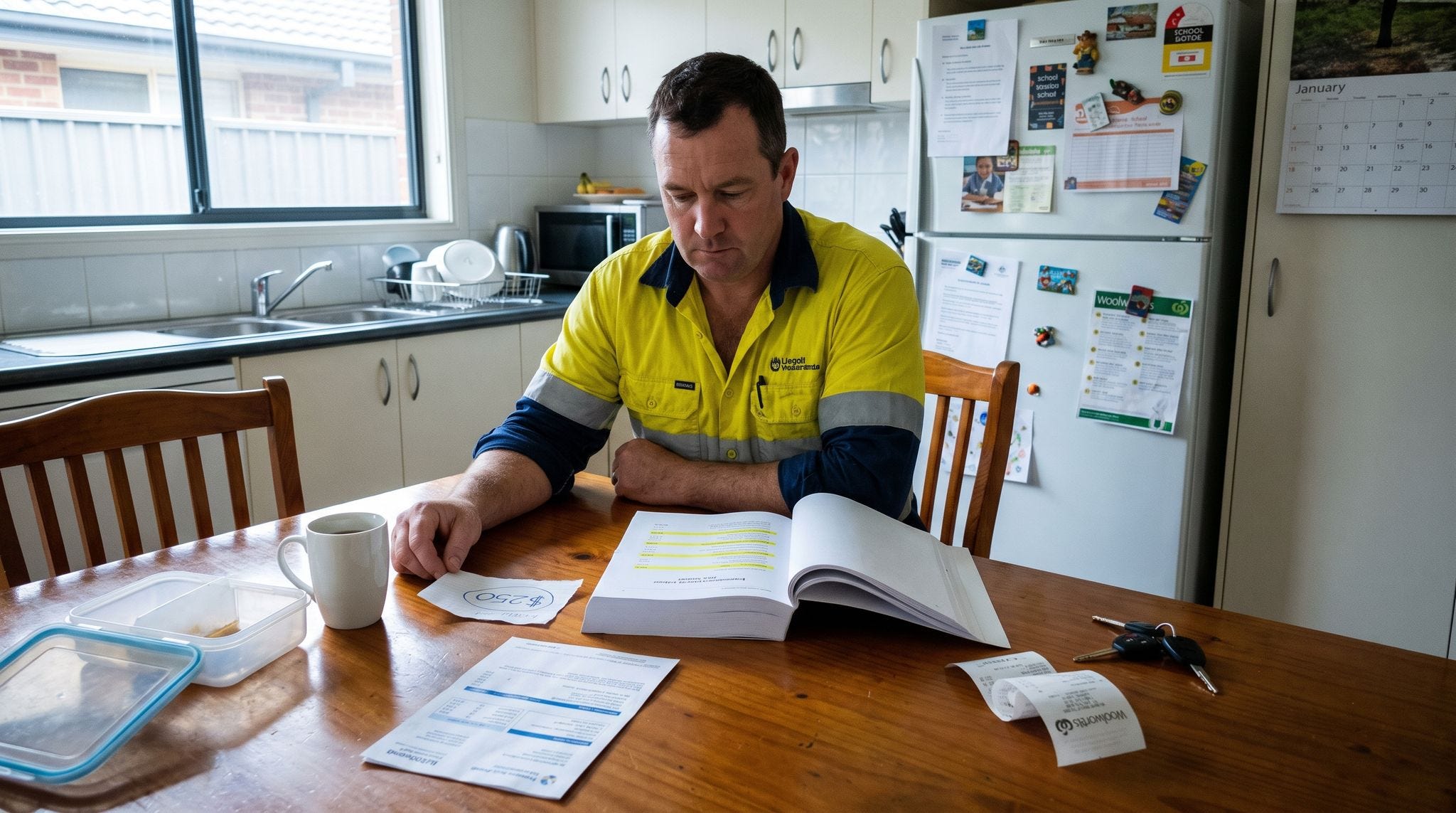
The 2026 Federal Budget was delivered on 12 May 2026. Here is what the Australian working family received from it. A $250 tax offset, claimable in the 2027-28 tax year, two financial years from now. That is the headline benefit of the budget for the median Australian taxpayer who actually pays for the budget. Two hundred and fifty dollars. Deferred. Take that figure with you as you read what follows.
Here is what other constituencies received in the same budget. Verified line items from Budget Paper No. 2.
$910.9 million for Refugee, Humanitarian, Settlement and Migrant Services in 2026-27 alone.
$793.7 million over five years for the Closing the Gap programme, on top of a 10-year $4 billion joint investment to halve overcrowding in remote Northern Territory communities, on top of $600 million in dedicated aboriginal housing through the Housing Australia Future Fund, on top of $218.3 million for the Our Ways – Strong Ways – Our Voices programme.
$604.2 million over five years for the government's social cohesion and enforcement package, including $124 million to the Executive Council of Australian Jewry for community security, $131.1 million for the Royal Commission on Antisemitism and Social Cohesion, $46.7 million for additional Jewish community support projects, $80 million for online counter-terrorism, $32.6 million for public awareness campaigns and $20 million for the Together for Humanity intercultural programme.
$550 million for climate-resilient infrastructure in the Pacific and Timor-Leste.
$148 million over three years to support Australia's role in COP 31.
$68.5 million over three years for HIV treatment and pre-exposure prophylaxis for arrivals who are not eligible for Medicare.
$64.6 million to recruit Papua New Guinean nationals into the Australian Defence Force, plus a further $35 million for 3,500 rifles for the PNG Defence Force, plus $7.7 million for a 200-bed training facility at the Goldie River Barracks, plus $2.2 million to design new barracks in Hela Province.
$25.3 million for the India-Australia Comprehensive Strategic Partnership, mainly for grants and fellowships.
$10.8 million across 2026 to 2028 for community-led health literacy initiatives for refugee and migrant women.
$6.6 million for Advanced Medium Range Air-to-Air Missiles for the United Arab Emirates.
That is a partial list. Budget Paper No. 2 runs more than 200 pages and there is more.
You got $250. Deferred.

The Working Australian Is Not a Constituency
The Australian political class has, over decades, built a way of working. It identifies constituencies. It listens to organised representations from those constituencies. It allocates resources in response to that pressure. Peak bodies are funded, line items appear, ministerial advocacy is dedicated, royal commissions are launched, special envoys are appointed, and the cycle repeats. This is not how the budget is written in some grand sense. It is, mechanically, how the budget gets written. The slow accumulation of organised pressure rewarded with line items.
The system works for those who organise. Aboriginal Australians have peak bodies, the Coalition of Peaks, dedicated ministerial portfolios, the Closing the Gap framework, an entire procurement policy, and a dedicated agency. The Jewish community has the ECAJ, the Anti-Defamation Commission, a Special Envoy to Combat Antisemitism, and now a Royal Commission. The refugee sector has the Refugee Council, the Asylum Seeker Resource Centre, settlement services, an institutional apparatus. The Pacific has treaty partners and ministerial forums. India has a Strategic Partnership. The renewables lobby has the Clean Energy Council. The universities have the Group of Eight. Big employers have the Business Council. Each constituency has organised, built representation, and received resources commensurate with the effectiveness of that representation.
The Australian working family has none of this.
There is no peak body for the Australian working family. There is no Special Envoy. There is no Royal Commission into the housing crisis. There is no ministerial taskforce dedicated to the cost of living. There is no dedicated funding stream, indexed annually, for the mainstream Australian household trying to keep up with mortgage payments and grocery bills. There is no lobby group with effective political access advocating for the structural interests of the people who pay for the budget.
What there is, instead, is a $250 tax offset, deferred until 2027-28, dressed up in language about generational fairness, while the energy and capital of the political class flows to every other identifiable constituency. The political class does not work for the working Australian family because the working Australian family does not organise, does not lobby, and therefore does not register as a constituency worth responding to.
That is the budget. Not a conspiracy. Not a plot. A system that responds to organised pressure and ignores disorganised need. And the Australians who get up every morning to keep this country running are now structurally disorganised.
The Foreign-Facing Spend
The cleanest part of the case is the spending that is, on its face, directed outside Australia or toward objectives that have no plausible benefit to the Australian working family.
$550 million to build climate-resilient infrastructure in Pacific Island nations, while Australian agriculture cannot get reliable affordable fuel and Australian construction cannot meet domestic housing targets. $148 million to support COP 31, a UN climate conference that has produced precisely nothing of consequence for any Australian's daily life. $25.3 million for the India-Australia Partnership, channelled into grants and fellowships of the kind that build careers for academics and consultants rather than infrastructure for Australians. $6.6 million to give air-to-air missiles to the United Arab Emirates. The UAE has one of the largest sovereign wealth funds in the world, and the Australian taxpayer is funding its missiles.
$64.6 million to recruit nationals of a foreign country into the Australian Defence Force. Read that sentence twice. The Pukpuk Treaty, signed in October 2025, opened a recruitment pathway under which up to 10,000 Papua New Guineans may eventually serve in the ADF. The first PNG permanent residents already in Australia became eligible on 1 January 2026. Australia is simultaneously paying to train PNG soldiers in PNG, paying for their rifles, paying for their barracks, and paying to recruit Papua New Guineans into our own military. The strategic logic of regional engagement is one thing. The strategic logic of solving an ADF recruitment problem by importing foreign nationals rather than addressing why young Australians no longer want to serve is something else, and no one in Defence wants to talk about the something else.
The $910.9 million for Refugee, Humanitarian, Settlement and Migrant Services in a single year sits in the same category, even though it is technically domestic spending. So does the $68.5 million for HIV treatment for arrivals not eligible for Medicare. So does the $10.8 million for refugee and migrant women's health literacy. None of these are foreign aid in the technical sense. They are domestic spending whose beneficiaries arrived from somewhere else and whose specific needs the budget chose to prioritise over the equivalent needs of Australians whose families have been here for generations. The Australian young man with severe mental health issues in a regional town gets a waitlist. The Australian disability pensioner gets her supports trimmed. The Australian working mother gets a deferred tax offset. The recently arrived migrant gets a dedicated, line-itemed, ministerial-attention-receiving programme. Not because the recent arrival is more deserving. Because the recent arrival has effective representation in the constituency negotiation, and the working Australian family does not.
This is what leadership subordinating itself to foreign interests actually looks like at the budget level. Not a conspiracy. A pattern of resource allocation that consistently prioritises non-Australian or recently-Australian interests over the structural needs of the Australian mainstream, because the political class has lost the conviction to say plainly that an Australian government's first obligation is to Australians.
The Architecture That Was Already Built
The largest single new spending category in the social cohesion portfolio deserves precise treatment, because the public framing of it does not match the chronology.
The Special Envoy to Combat Antisemitism, Jillian Segal AO, was appointed in July 2024. Ms Segal is a former president of the Executive Council of Australian Jewry, the organisation that has since received the largest share of community security funding. Ms Segal delivered her Plan to Combat Antisemitism to government in July 2025. The Plan contained 13 recommendations and 49 key actions, several of them implemented immediately. The full government response and adoption of the Plan was announced on 18 December 2025.
On 14 December 2025, fifteen people were killed at a Chanukah celebration at Bondi, including a 10-year-old child and an 87-year-old woman. Two gunmen carried out the shootings. People died. That much is on the record.
What there is to argue about is the framing that followed.
The Plan to Combat Antisemitism, the IHRA Working Definition of Antisemitism adopted across the Australian Public Service in 2024-25, the speech-restriction and symbol-restriction laws legislated before Bondi, the doxxing laws legislated before Bondi, the appointment of a Student Ombudsman, the $90 million invested in initiatives before the Plan was even delivered, the prohibited-group listing framework, and the integration of the Special Envoy's recommendations into government workstreams were all in motion well before December 2025. Bondi did not produce the architecture. The architecture was substantially complete. Bondi delivered the political moment to finalise its adoption, expand the funding, launch the Royal Commission, and enact migration law changes that had been on the policy radar but lacked a triggering event sufficient to push them through.
This is a textbook example of the structure that political scientists, sometimes invoking a weaponised reading of Hegel, describe as problem-reaction-solution (hegelian dialectic). The solution sits on the shelf, fully designed, waiting for the moment the public will accept it. The problem arrives, manufactured, facilitated, or genuinely occurring, it does not matter mechanically. The public reaction is immediate and overwhelming. The pre-prepared solution is offered as the only available response, and the political class executes the deployment in the small window before the public's analytical faculties catch up with its emotional response. The architecture goes live. The window closes. The synthesis was the destination all along. The crisis was the vehicle. Whether one believes the vehicle was steered or merely seized upon, the mechanism is the same and the outcome is identical.
This is the part the political class does not want examined and so distraction points in the direction of the security elements. Charlie Kirk famously asked in 2023 about another event overseas “who gave the stand down order?”. When security fails or a meaningful response is delayed, that is a legitimate and important question. It is also, in its loudness, a useful place to look while the more consequential question goes unasked. What was already on the shelf, who put it there, and how long had it been waiting for the right moment to be deployed.
All three questions are worth the time to answer and the answers, on the public record, point in the same direction.
What was on the shelf was a legislative and funding architecture in the order of $604 million, much of which was developed before Bondi and much of which extends well beyond the security response Bondi appeared to justify. The Royal Commission's terms reach into education curriculum, social media regulation, university administration, prosecutorial training and migration law. The IHRA definition has been embedded across the public service with implications for speech about a foreign state. Migration legislation has been amended to create new visa cancellation and refusal grounds tied to conduct categories defined by the new architecture. The Special Envoy's role is permanent and supported by ongoing budget allocations.
Who put it there is also on the record. A former president of the ECAJ, the organisation now receiving the largest share of community security funding, occupies the Special Envoy role designed to address concerns the ECAJ raises and direct resources the ECAJ receives. The Plan adopted by government in December 2025 was authored by the same Special Envoy who had been in the role since July 2024. The architecture was not assembled by a neutral committee balancing competing community claims. It was assembled in close and continuous consultation with a single community's peak body, by a former office-holder of that peak body, and adopted in the political moment a crisis created. The fox is in the hen house, and the fox wrote the security plan.
How long it had been waiting is the easiest of the three to answer. Eighteen months from the Special Envoy's appointment to the formal adoption of her Plan, with the Plan delivered to government in July 2025 and the political window to adopt it arriving on 14 December 2025. The pieces that did not require the crisis (the IHRA definition, the speech-restriction and symbol-restriction laws, the doxxing laws, the $90 million in pre-Plan investment, the Student Ombudsman) were legislated and operationalised in the eighteen-month interim. The pieces that did require a crisis to clear the political resistance (the Royal Commission, the additional ECAJ funding, the migration law changes) were ready to deploy the moment the crisis arrived.
None of this is illegal. None of it is hidden. All of it is on the public record. What it is, plainly, is a policy architecture of unusual scope, developed in close consultation with a single community's peak body, funded substantially by the Australian taxpayer, and extending into speech regulation, migration policy, and foreign policy alignment with a degree of integration that no other constituency in Australia enjoys. The Australian working family does not have a Special Envoy. Aboriginal Australians do not have a Royal Commission with this scope. No other group has secured a comparable interlocking arrangement of permanent representation, legislative architecture, and dedicated funding.
That is not a comment on the Bondi attack, which was real. It is a comment on the architecture, which is large, and the chronology, which is on the public record. A working Australian who is now paying for both is entitled to ask why their own crises have received nothing of comparable scale and scope, and why the architecture that protects one community could not be matched in some form, however different in character, for the housing, cost-of-living, and security concerns of the rest.
The answer is the one this whole article keeps arriving at. Organised pressure produces resources. Disorganised need produces deferred $250 tax offsets.
The Closing the Gap Question
The Closing the Gap programme has been the largest sustained line of aboriginal-targeted spending in Commonwealth budgets for two decades. The 2026 budget allocates $793.7 million over five years to the National Agreement on Closing the Gap, plus $218.3 million for the Our Ways – Strong Ways – Our Voices plan, plus an additional $144.1 million for Aboriginal Community Controlled Health Services infrastructure, plus a 10-year $4 billion joint investment to halve overcrowding in remote Northern Territory communities, plus continuing investment in remote employment, ranger programs, education, and digital connectivity. Indigenous-specific measures in the 2026 budget total approximately $1.31 billion.
The actual outcomes for aboriginal Australians, after twenty years and tens of billions of dollars, have moved on most indicators by margins so small that the programme's own annual reports describe several targets as "not on track." That is not the assessment of outside critics. It is the assessment of the agency administering the programme, evaluating itself, in documents the Commonwealth publishes annually.
The reason is not difficult to identify if you look at where the money actually goes. The funding flows to peak bodies, to Aboriginal Community Controlled Organisations, to national bodies and state-level intermediaries, to consultancies, to programme administration, to evaluation contracts, to reconciliation initiatives, to bureaucratic infrastructure. By the time it reaches the actual aboriginal communities the programme exists to help, much of it has been absorbed by the apparatus that exists to deliver it.
This is not a critique unique to aboriginal Australians. It is the standard problem of identity-targeted spending across every category. The architecture grows. The organisations grow. The administrative overhead grows. The outcomes for the supposed beneficiaries grow more slowly than any of the above. The political class points to the architecture and claims credit for the spending. The supposed beneficiaries get the marginal increment that survives the journey through the apparatus.
The honest position is that aboriginal Australians are Australians. The structural needs in remote and regional aboriginal communities are real. Health outcomes, educational outcomes, employment outcomes and incarceration rates remain unacceptable. Targeted programmes that actually delivered to the communities that need them would be defensible. What is harder to defend is a $1.31 billion annual ledger that produces another year of "not on track" reports while sustaining a national peak body apparatus that has become a constituency in its own right.
The same pattern applies, in different form, to every cohort-targeted programme in the budget. Refugee settlement services, the social cohesion architecture, multicultural affairs, the gender-equality apparatus, the disability-services bureaucracy that has produced the NDIS cost blow-out. Each has its peak body. Each has its dedicated funding stream. Each has its captured ministerial channel. Each has its army of consultants, evaluators, and administrators. And each has produced outcomes that the people the programmes ostensibly serve report, with depressing consistency, as inadequate.
This is the structural pathology of the modern Australian budget. The political class has stopped funding outcomes and started funding architectures. The architectures sustain themselves. The architectures defend themselves. The architectures produce reports that justify further architecture. And the Australian working family pays for all of it without representation in any of it.
The Migration Numbers Beneath Everything
Underneath the budget figures sits the demographic reality that makes them coherent.
In the twelve months to January 2026, Australia took in 480,520 people on a net permanent and long-term basis. That is the highest figure in this country's recorded history. There are now 2.98 million temporary visa holders on Australian soil. Also the highest figure on record. Net overseas migration added 311,000 people to the population in the year to September 2025. The 2026 Budget projects net overseas migration of 245,000 for 2026-27. Treasury's own forecasts have been exceeded, year after year, by 30 to 40 per cent. There is no reason to believe the 245,000 figure either.
Australia's migrant population has more than doubled since 2000. The housing stock has grown by 54 per cent in the same period. The supply gap in the 2025 financial year alone was 262,500 dwellings. Housing approvals collapsed 15 per cent in December 2025. The average Australian home now costs $1.016 million.
The political class is importing people faster than it can house them, employ them, or absorb them. It is then funding settlement programmes, health literacy, language training, employment support and identity-specific services for the arrivals it has chosen to import, while telling the existing Australian population that its housing crisis is a market problem.
This is not bad luck. This is policy. The policy of a political class that has decided the country's role is to function as a managed estate for whoever the political class chooses to invite. The owners of the estate are not consulted. They are billed.
The Uni-Party's Subordination
This was not done by one party. It was done by both.
The Liberal-National Coalition presided over a decade of record-breaking immigration intakes, signed off on the temporary visa system that produced the current 2.98 million backlog, and built no integration framework, no demographic target, and no case to the Australian public for what it was doing. It then handed the file to Labor and pretended its hands were clean.
Labor has been worse only in the specific sense that Labor promised to do better and did not. The Albanese government pledged in 2023 to cut migration back to sustainable levels. Net overseas migration of 480,000 was the result. The promised reductions were quietly abandoned. The structural drivers, including uncapped student categories and the temporary visa economy that powers the cheap-labour end of the workforce, remain untouched.
Both parties answer to the same donor ecosystems. Both parties answer to the same university sector that has rebuilt itself around foreign-student revenue. Both parties answer to the same employers who have learned that domestic wage pressure can be neutralised by importing labour at scale. Both parties answer to the same media class that treats any honest discussion of migration as a moral failing rather than a policy question. Both parties answer to the same foreign-policy establishment that treats every treaty as a one-way concession and every Pacific commitment as an Australian obligation rather than a negotiated trade. Both parties answer to the same peak-body ecosystem that has captured every identity-targeted programme in the budget.
Different jerseys. Same game plan. Same result.
Decisions react to conditions. Choices create them. The current settings were a sequence of decisions. Each year's intake reacted to lobbying pressure. Each year's budget reacted to organised representation. Each treaty reacted to diplomatic momentum. No one chose, in any meaningful sense, the country that would be produced by the accumulation of those decisions. No one was asked to choose. That is the failure. Not the existence of any particular programme. The absence of choice.
That is not governance. That is capitulation dressed as consensus.
What Backbone Looks Like
Backbone is not difficult to describe. It is rare.
Backbone is a national leader who stands at the budget lock-up and says, plainly, this country's first obligation is to its own people. Not in a slogan. As an operational principle that determines line-item allocation. The Australian working family gets the first share of available resources. Foreign engagement gets the share remaining after that first obligation is met. Constituencies organised around identity, sector, or interest get the share remaining after both. The order is not negotiable, because the order is what makes the country a country rather than a managed pool of competing claims.
In the work I do with organisations I use a tool called the Standards Sniper™. Its premise is direct. "They should know" is one of leadership's biggest lies. People do not know unless you tell them. Standards do not transmit by osmosis. They are written, demonstrated, and reinforced, or they decay. The same principle applies to a country. A political class that has never written down its first obligation, never defended it publicly, never refused a constituency that would have breached it, has not been even-handed. It has been negligent. The expectation that the Australian working family will continue to fund a system that does not serve them, indefinitely, without consent, is the expectation of people who have lost contact with the country they are supposed to govern.
Backbone is a treasurer who looks at the foreign-facing spend, the constituency-targeted spend, and the deferred $250 tax offset, and asks which of those three signals the country he actually works for. Backbone is a defence minister who says we will fix Australian recruitment by addressing why young Australians do not want to serve, before we ask Papua New Guineans to fill the gap. Backbone is a home affairs minister who tells the migration sector, the universities, the employers, and the settlement industry that net migration will be set by housing supply, infrastructure capacity, and labour market absorption, indexed annually, presented honestly, and reduced when the country cannot keep up.
Backbone is a prime minister who, after the attack at Bondi, funds the security response that responds to that attack, and at the same time refuses to extend the legislative architecture beyond what the security response actually required, and at the same time says, in the same address, that the Australian working family is also a constituency this government serves, and here is what this government is going to do for them, in this budget, not deferred until 2027-28.
None of this is radical. None of it is clever. It is basic conviction. The kind any competent national leader should have been bringing to the work for the last four decades.
Instead, we got administrative drift. We got economic arguments dressed up as moral imperatives. We got architectures funding architectures funding architectures. We got a political class that decided the Australian public was a problem to be managed, not a sovereign people to be served. We got a country whose budget reveals, line by line, that the people who pay for it have been quietly relegated to the back of the queue in their own home.
The Conviction
Conviction has two meanings on this masthead. One is the backbone leaders are supposed to bring to the work. The other is the verdict that should follow when leaders fail to bring it.
This is a verdict piece.
The Australian political class, across both major parties, has failed the most basic test of national leadership. It has built a budget process that responds to every organised constituency, foreign or domestic, except the one it exists to serve. It has imported people faster than it can house them. It has subordinated Australian wages to foreign labour supply. It has subordinated Australian housing capacity to foreign student revenue. It has subordinated Australian young men's military service to a foreign recruitment pathway. It has subordinated Australian taxpayer resources to climate conferences, treaty partners, settlement programmes, and identity-targeted architectures while the Australian working family gets a deferred $250. It has, year after year, built peak-body ecosystems that absorb the funding meant for the people the funding was nominally for, and called the resulting opacity "consultation."
This is what subordination looks like in the budget. Not a single grand betrayal. The cumulative weight of a thousand decisions, each one defensible in isolation, each one signing away another fraction of the country's first obligation to its own people, until what is left is a political class telling the working Australian family that its complaints are extreme, its discontent is bigotry, and its concerns are unwelcome in polite discussion.
The country is being told to sit quietly at the back of the queue while the people the political class actually answers to are served first. That is the message. It is delivered in line items. It is on the public record.
The question is not whether Australians will accept this indefinitely. They will not. The question is whether the political class that produced it will be replaced by something with backbone, or by something worse. That is the choice in front of this country. Not whether to be governed. By whom, and in whose service.
The country was promised better. It deserves better. And it will, in time, demand better. The work now is to make sure that demand is met by leaders worth the name, before it is met by something else.
Paul Lange advises owners, executives, and boards on the decisions that define commercial outcomes and organisational character, and on what a working board actually contributes. He has spent close to four decades across finance, technology, hospitality, professional services, and operating roles, in Europe, Asia, the Middle East, and Australia, on both sides of the table, with private equity and venture capital one part of it, and has taken five of his own companies through to exit. He is the creator of the Total QX™ and TILE Theory™ frameworks, and the author of The 20% Leader, Mis(très)s Entrepreneur Manifesto, Evolve or Be Remembered, and The Inheritance Manifesto. He runs his advisory practice, Manolutions, from the Gold Coast, Queensland. He writes Conviction because leadership without accountability is just theatre.