
Not since Breaker Morant.
This article draws on the Bezmenov framework that sits behind a six-part series in the Conviction newsletter. If you are unfamiliar with Yuri Bezmenov, the former KGB agent who defected to the West, and his four-stage model of ideological subversion, reading the first article in that series first may help. It is not essential.
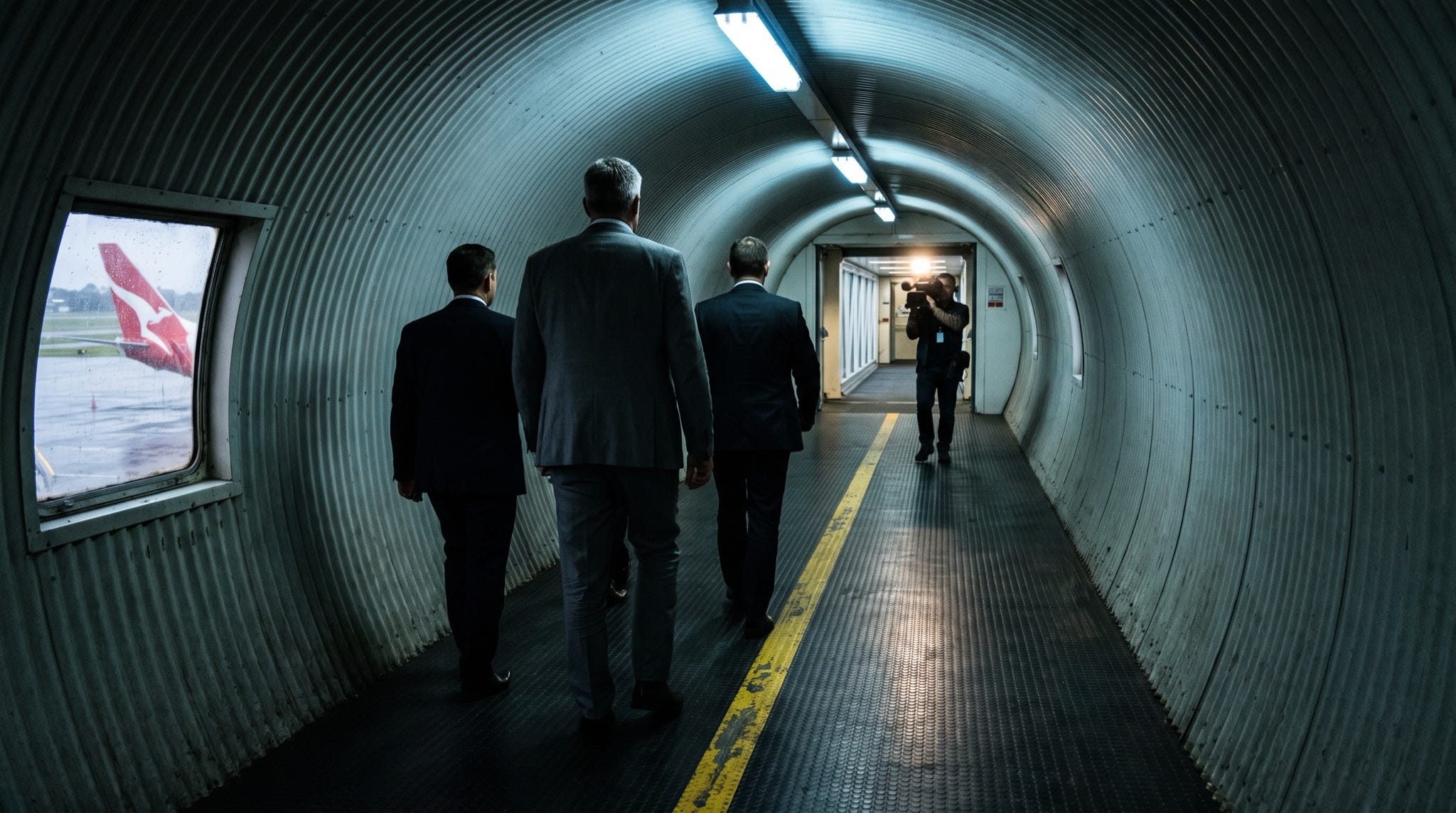
The photograph was released by the Australian Federal Police and the Office of the Special Investigator within hours of the arrest. A former Special Air Service corporal being walked down an aerobridge by plain-clothed officers on a Tuesday morning. Flight clothes. Grey hair cropped short. The bearing of a man who has absorbed worse and held his ground.
18 days before ANZAC Day.
Ben Roberts-Smith is Australia's most decorated living soldier. Victoria Cross. Medal for Gallantry. Commendation for Distinguished Service. On the morning of 11 June 2010, at Tizak in Kandahar Province, he charged three machine gun positions alone to draw fire away from his pinned-down patrol. The citation describes "conspicuous gallantry and daring in the face of the enemy." On 7 April 2026, he was walked through Sydney's domestic terminal in handcuffs, filmed by Channel Nine, and remanded to Silverwater Correctional Complex. He has since been released on bail.
His lawyers had offered, repeatedly and formally, to surrender him to police at any time and in any location. The offer was declined.
This was not incidental. His father is Len Roberts-Smith KC, former Justice of the Supreme Court of Western Australia, former Major General, and former Judge Advocate General of the Australian Defence Force. This is a family that understands military law and due process at the highest level in this country. The surrender offer was made formally, properly, and through channels any senior police commander would have recognised as legitimate and good faith.
It was declined anyway. What replaced it was theatre.
In his first public statement after his release on bail, Roberts-Smith described the arrest himself. "A deliberate sensational arrest." "An unnecessary spectacle." He has categorically denied every allegation. He said he acted, throughout his service in Afghanistan, "within my values, within my training, and within the rules of engagement." He said he had never run from a fight in his life and would not start now.
That last line is worth pausing on. It is the grit of a true Australian. The grit this country used to be known for, before several decades of managed decline taught the national character to apologise for itself. Whatever else is true of Ben Roberts-Smith, the man does not fold. That alone has become rare enough in public life to be worth noting.
It is also worth noting how he talks about the people around him. He opened his statement with his family and closed it by honouring the men and women who served alongside him, "particularly those who made the ultimate sacrifice, many of whom were my friends." Not a word of self-pity. Not a syllable directed at saving his own skin at anyone else's expense. No attempt to blame a subordinate, a superior, or the rules of engagement he says he followed. That is the bearing of a man who believes himself to be in the right and is prepared to prove it. It is not the bearing of a man who has gone rogue, as the narrative around him has laboured to suggest for seven years.
Believe the man or do not. The record is available. What follows is not an argument about the criminal charges. A trial, if it proceeds to one, will answer that question. What follows is a description of what has been done around the man by a political class, a media apparatus, and a federal police leadership that have, between them, produced something that belongs in a much older and more shameful chapter of Australian history.
Not since the British shot Lieutenant Harry Harbord "Breaker" Morant and Lieutenant Peter Handcock in the dust of Pretoria has an Australian soldier been so comprehensively set up as a scapegoat for decisions made well above his rank. That was 1902. The book written afterwards by the surviving officer, George Witton, was titled Scapegoats of the Empire. It has been taught in Australian schools for over a century as a founding wound of the national character. A British command let it be known, unofficially, that Boer prisoners were not to be taken. Australian lieutenants carried out the orders. British officers walked. Australian officers were shot.
What is happening now fits the pattern. Not perfectly. No two historical episodes ever do. But close enough that any Australian with a functioning memory should be uncomfortable.
The Framework
This is the first stage in Bezmenov's four-stage ideological subversion framework. Demoralisation. The slow, deliberate erosion of a society's ability to trust its own reference points, its own history, its own heroes.
A Victoria Cross recipient is, almost by definition, a reference point.
When a state walks its most decorated living soldier off a commercial flight in full view of a tipped-off television network, the purpose is not to enforce the law. The law could have been enforced quietly, at a police station, at a time mutually agreed between the AFP and his legal team. That was on offer. It was refused.
The purpose of the spectacle is the spectacle. And the message of the spectacle, to every Australian who has served, every Australian who might serve, and every Australian still capable of recognising courage when they see it, is unmistakable. The state will use you, decorate you, and then feed you to the machine when the political winds shift.
That is not a justice system malfunctioning. That is an ideological operation working exactly as designed. Working against you. The people.
The cost is not only to Roberts-Smith. The cost is paid by every 19-year-old in a country town watching this unfold and quietly deciding that the uniform is not worth what the country will do to the man who wears it. Every father who might once have been proud to see his son enlist now has a different conversation at the kitchen table. Every potential recruit learns, years before the enlistment office, that the Australian state will decorate its soldiers when politically useful and discard them when politically expensive. Recruitment does not recover from lessons like that for a generation. That is not a side effect of the spectacle. That is part of what the spectacle is for.
No Officer Will Be Charged
In 2020, the Inspector-General of the Australian Defence Force released the Brereton Report. It found credible information of 23 incidents involving 39 unlawful killings by 25 Australian personnel in Afghanistan between 2005 and 2016. It recommended 19 soldiers be referred for criminal investigation.
Every one of them was a corporal, a sergeant, a trooper, or an NCO.
Not a single officer, from lieutenant to lieutenant-general, was recommended for investigation. The report's explanation was that commanding officers at every level of the Australian military were not in a position to know, or even become suspicious, that their subordinates were committing unlawful killings across a decade of deployments in a single province.
Read that again.
Either that explanation is true, which means the Australian officer class failed so catastrophically in its basic duty of command that it should have been dismissed en masse, or it is not true, in which case section 268.115 of the Commonwealth Criminal Code applies. That section imposes criminal responsibility on a commander who knew, or was reckless as to whether, forces under their effective control were committing war crimes. It has existed in Australian law for over two decades. It has never been used against an Australian officer.
So the state now pursues a corporal under that same Criminal Code, using evidence gathered under command structures whose senior officers have been declared, by the very inquiry that generated the charges, either blind or protected. Pick one. Both answers indict the officer class. The state chose instead to indict the trigger-puller and leave the chain of command untouched.
This is Breaker Morant's ghost. A century and a quarter later. Same pattern. The men who gave the orders, or at minimum set the culture in which the orders were carried out, wear their ribbons at official dinners. The man who carried out the consented acts is the one facing life imprisonment.
The Foundation Stone Is Cracked
The Brereton Inquiry was meant to be independent, confidential, and at arm's length from the media. It was none of those things.
Roberts-Smith's lawyers have spent years pursuing diary entries from Major General Paul Brereton through the Administrative Appeals Tribunal, on the grounds that Brereton met journalist Chris Masters on three separate occasions in 2017, before the inquiry's public work had properly begun. Masters, a co-author of the 2018 reports that form the basis of the entire public narrative, allegedly received access to classified defence information during those meetings. Brereton directed that his own diary entries be restricted one week after Roberts-Smith lodged his freedom of information request.
Brereton is now Australia's anti-corruption commissioner. It emerged in early 2026 that he has continued to consult with the IGADF on his own inquiry, informally and without pay, on roughly 22 occasions since 2023. He initially failed to disclose this. He has since recused himself from defence-related referrals.
Pause on that. The man now charged with policing corruption across Australian public life is the same man whose inquiry into Australian soldiers began with undisclosed meetings with a journalist, whose diary entries were restricted within a week of a freedom of information request from the subject of that inquiry, and who continued for years to informally advise the office that now prosecutes, without initial disclosure of any of it. If that is the standard of disclosure expected of the anti-corruption commissioner, one has to ask what standard is being applied to the rest of us. There is a word for this arrangement. The word is irony. There is a longer word. That word is corruption.
The foundation stone of every subsequent proceeding, the defamation trial, the appeal, the criminal charges, is the Brereton Report. If the inquiry that produced it was compromised by pre-existing contact with journalists, by selective classification of evidence, and by ongoing undisclosed relationships between its author and the investigating office, then everything built on top of it is suspect.
This is not speculation. It is a matter of court filings and parliamentary record. The man who wrote the report that underwrites the prosecution has been informally advising the office that prosecutes, while holding the role of the nation's anti-corruption watchdog.
If that does not disqualify the process, nothing does.
The Co-Prosecutor Wears a Press Pass
Nine Entertainment is not a neutral observer in this story. It is a participant.
Its journalists published the original 2018 allegations. Its legal team defended the defamation case brought against it. During the course of that defence, evidence emerged that one of its star reporters allegedly received privileged legal strategy from Roberts-Smith's ex-wife and her associates. Nine subsequently paid $700,000 in a confidential settlement to a key witness, known in court as Person 17, to prevent Person 17 from going public with allegations about the conduct of Nine's own journalist. The Nine board has refused to answer questions about who authorised the payment.
Two of the AFP's original criminal investigations were abandoned due to concerns over potentially inadmissible evidence. The cases had to be reconstructed under a new joint taskforce.
On 7 April 2026, when Roberts-Smith was finally arrested, Nine was the only news organisation with cameras present. It received, according to sources close to his defence, approximately a day's advance notice. The aerobridge photograph was released through official AFP and OSI channels within hours. It was not a Nine exclusive. It was a joint production.
That is not journalism. Journalism observes. Journalism holds power to account. What Nine has done over seven years is co-prosecute a criminal case in the court of public opinion while simultaneously paying witnesses, allegedly receiving privileged material, and receiving operational tip-offs from the federal agency conducting the arrest.
A free press cannot function as a co-prosecutor. When it does, the population loses two institutions at once. The judiciary, because its process has been pre-empted. And the press, because its credibility has been merged with the entity it was meant to scrutinise.
The Campaign of Imagery
It is not enough that he is accused. The campaign has required, across seven years, a sustained release of imagery calibrated to inflame rather than inform.
Consider the Crusader's cross. In April 2010, Roberts-Smith was photographed on operations in Afghanistan wearing a shield patch on his uniform bearing a Crusader's cross. When the Department of Defence released an official photograph from that same day in January 2011, the cross had been digitally removed. A plain shield remained. The state, in other words, saw the symbol, judged it operationally counterproductive in a Muslim country, and sanitised the image for public release. Was that diplomacy, or the woke agenda at work? That was 2011.
The original unedited photograph, complete with the cross, surfaced in the Sydney Morning Herald and The Age more than a decade later, at a moment calibrated to maximum reputational damage during the defamation proceedings. The image did not leak itself. Somebody with access to Defence archives handed it over. The same institution that had sanitised the image in 2011 leaked the original in 2021. Why? Because the Crusader's cross, presented in full, added a layer the murder charges alone could not. It allowed the reporting to be framed not merely as allegations of unlawful killing, but as the actions of a Western Christian against Muslim victims. That framing plays in exactly one direction in contemporary public discourse.
What the media coverage did not mention is that the Special Air Service cap badge, worn by every member of the regiment from the day of enlistment, is itself a flaming sword set upon a Crusader shield. It has been so since David Stirling designed it in Cairo in 1941, and the Australian SASR inherited it when the regiment was formed in 1957. The Crusader cross worn by Roberts-Smith was not the mark of a rogue religious crusader. It was a variant of his own regiment's official iconography, consistent with a morale patch culture that runs across Western special forces units globally and is sold openly to this day on Australian military supply websites. A journalist curious about context rather than scandal could have established this in an afternoon. None did. The reader was asked to see religious extremism where any serving soldier would have seen a unit tradition older than Australia's involvement in the Pacific War.
The Crusader's cross is one example. The pattern repeats. Photographs from soldiers' parties. Images of trophies. Costumed antics at an unauthorised base bar called the Fat Ladies Arms. Vignettes of poor judgement and drunken behaviour a decade old, curated and released in waves timed to court milestones. In many of those photographs, other soldiers wore the costumes and set the scenes. Roberts-Smith does not appear in most of them, and where he does, he is in the background of imagery staged by others. That distinction was routinely blurred in the public framing. None of these images proves the murder charges. All of them shape the public mind that will, eventually, sit in judgement.
A man accused of murder should be tried on the evidence of the alleged murders. Not executed in the public imagination through a decade-long drip feed of photographs, patches, and party antics. That is not journalism. That is an operation conducted against a man the state has already decided it no longer needs.
The Commander Who Will Not Explain
Krissy Barrett became the ninth Australian Federal Police Commissioner on 4 October 2025. She is the first woman to hold the role. She rose through the AFP's Melbourne command during the Victorian lockdown era, the most restrictive, oppressive and tyrannical civilian policing environment in the democratic world, and was promoted to Assistant Commissioner Southern Command in 2021. She holds nine service medals. None are combat decorations. That is a factual observation, not a moral one. Policing and soldiering are different professions.
But operational leadership is operational leadership. And on 7 April 2026, Commissioner Barrett authorised an arrest that rejected a formal offer of surrender, tipped off a single media outlet, and produced a photograph released through government channels within hours. When asked to explain the operational reasoning at a press conference days later, her response was that there were considerations she would not go into.
That is not accountability. That is the refusal of accountability by the commander who now runs the nation's federal police force. She is rubbing the nation's nose in it. Essentially saying that she is not answerable to the people. Which begs the question to whom, exactly, is she answerable?
It is the exact inverse of the accountability the state is demanding from Roberts-Smith. He is being asked to answer under oath, at the highest evidentiary standard, for decisions made under fire in a foreign country under rules of engagement that shifted repeatedly during his deployments. Barrett, making a decision in an air-conditioned office in Canberra, cannot explain why she refused a voluntary surrender.
The institutional culture she rose through has form. Victoria Police, under the Andrews government, arrested a pregnant woman in pyjamas in her own home for a social media post. It deployed rubber bullets at the Shrine of Remembrance. It ran drone surveillance over suburban backyards. It treated ordinary disagreement with policy as extremism. Barrett did not author that culture. She rose through the AFP's operational command during its peak and was decorated inside it. The culture that normalised those tactics is the same culture that now stages airport spectacles for criminal arrests. Same instincts. Same preference for optics over process. Different target.
The AFP did not invent the playbook. It inherited it.
Three Hundred and Eighteen Million Dollars. Two Charges. No Names.
Ten years. $318 million of taxpayer funds allocated to investigating Australian conduct in Afghanistan. Two soldiers charged. The first, Trooper Oliver Schulz, arrested in 2023 and still not tried. His trial has been scheduled for 2027.
Roberts-Smith is the second.
The Office of the Special Investigator's Director of Investigations, Ross Barnett, has publicly stated that his team cannot access the crime scenes. There are no photographs. No site plans. No measurements. No recovery of projectiles. No blood spatter analysis. No access to the bodies. No post-mortems. No official cause of death. No way to link any weapon to any death.
Court documents have since revealed that two of the five Afghan men Roberts-Smith is accused of murdering have never been identified by investigators. One is described only as "Person Under Control 1" or "Enemy Killed in Action 3." The other, "Person Under Control 2" or "Enemy Killed in Action 4." After a decade of investigation and $318 million of public money, the prosecution cannot name two of the five people it claims were unlawfully killed.
And then there is the part that goes largely undiscussed in polite company.
Australian taxpayer money was deployed, as part of this investigation, to actively solicit testimony from Afghan nationals in rural Uruzgan Province. As reported by former SAS members and covered extensively online, posters were placed in Afghan villages offering rewards for information against Australian soldiers. The mainstream Australian press has been largely silent on this dimension of the investigation, which is unsurprising given that this article has already established where the mainstream media sits in relation to this story. Whether the precise mechanism was posters alone, cash payments, interpreter fees, resettlement assistance, or some combination, the broader pattern is on the record. The Australian government deployed resources to recruit foreign nationals, in the home villages of men killed by Australian soldiers in the fog of counter-insurgency, to build a legal case against those soldiers.
In a province where annual household income is measured in a few hundred dollars, any inducement that approaches the equivalent of a year's wages is not evidence. It is a transaction. The witness has no independent standing because the witness has an overwhelming financial reason to provide whatever version of events the transaction appears to require. Any competent defence lawyer will drive a truck through that.
But the broader point is not evidentiary. It is moral. A government that spends public money to recruit foreign witnesses against its own soldiers has inverted the basic contract of national service. The soldier is dispatched on behalf of the state and then, when the political wind changes, the state goes looking for foreign nationals willing to testify against him in exchange for payment. That is not justice. That is betrayal. The plainest word for it, and the one this article will use, is treachery.
This is the state that Roberts-Smith has told the Australian public he intends to fight, all the way, to clear his name. Given what Barnett has already conceded on the record, the prosecution is not walking into a simple case. It is walking into a prolonged public legal battle with a man who has spent his adult life running toward machine gun positions. The government appears to have forgotten that.
What I Think
Nearly four decades of watching organisations handle people have taught me how institutions protect their own, and who they choose to sacrifice when protection is no longer possible. The pattern that produces spectacle in place of process is the same pattern every time.
I was not in Afghanistan. I was not on a single deployment. I have no standing to pass judgement on the specific, split-second decisions made in compounds and creek beds under rules of engagement that shifted almost monthly. Nobody who has not been there does.
But reading the rest of it does not require having been there.
A report that names 19 NCOs and zero officers. Court filings showing the head of the inquiry met privately with journalists before the inquiry began. A public admission from the lead investigator that there are no bodies, no forensics, no named victims in two of five charges. A media company that paid $700,000 to silence a witness, allegedly received privileged legal material from the ex-wife of the accused, and was given advance notice to film the arrest. A decade-long drip feed of patches, photographs and party imagery curated for maximum damage rather than public interest. A Commissioner's refusal to explain her own operational decisions. An accused who, on national television, publicly asserts his innocence, describes the arrest as a sensational spectacle, and announces that he intends to fight. A foreign witness programme funded by the Australian taxpayer to build a case against Australian soldiers.
Put all of that on one side of a pair of scales. On the other side, put the proposition that the Australian state has conducted itself honourably in this matter and that Roberts-Smith is the architect of his own fate.
The scales do not balance.
I cannot say Ben Roberts-Smith is innocent of the specific acts alleged. My gut instinct says he is, and everything in his conduct across seven years of litigation and now into a criminal trial suggests a man who believes himself to be. But I was not there. Neither were the journalists. Neither were the officers who escaped investigation. Neither was Commissioner Barrett. Neither was Justice Brereton.
The hardest element of the case against Roberts-Smith is the testimony of fellow SAS members. Men who served alongside him. Men trained in a culture where internal loyalty is close to absolute. That they testified against one of their own is not nothing. For many observers, it is the single most persuasive element of the prosecution's case.
It is also the element most likely to have been engineered.
Consider what we already know. A seven-year investigation. Financial support for legal fees provided by interested parties. Promises of anonymity. The threat of prosecution hanging over witnesses who did not cooperate. Potential immunity arrangements. Sustained pressure from the media company that was simultaneously being sued by the accused. A lead investigator who cannot produce bodies, forensics, or the names of two of the alleged victims, who nevertheless secured enough cooperating witnesses to bring charges. The conditions under which the testimony was gathered are not incidental to its content. They are the engine that produced it.
If this sounds familiar, it should. The American public watched, across almost a decade, as senior intelligence officials signed letters and gave testimony framing Donald Trump as a Russian asset. It was presented as the professional judgement of independent agencies. It was treated as gospel by every major media outlet in the Western world. It has since been declassified and referred to the Department of Justice for criminal prosecution. The Director of National Intelligence, Tulsi Gabbard, referred Barack Obama himself to the DOJ in July 2025 for his role in ordering and coordinating what the declassified documents describe as a treasonous conspiracy. A grand jury has been convened. John Brennan and James Comey are under active FBI investigation. The operation was initiated by the Clinton campaign, sanctioned at the highest levels of the Obama White House, executed through the intelligence agencies, and sustained for years by a compliant media. Every single person involved knew exactly what they were doing. The testimony appeared independent. It was coordinated from the top.
The men giving that testimony were not mad. They were not lying in the simple sense. They were participating in a coordinated institutional operation dressed up as independent professional judgement. The same playbook does not require the same players. It requires only the same conditions. Institutional pressure. Career consequences. Financial inducements. Legal threats. Media amplification. A sanctioning political authority at the top of the chain. Produce those conditions and the testimony follows. That is not a theory. That is a demonstrated pattern of operation, now on the public record, against one of the most visible political figures of the modern era.
Twenty or so serving and former SAS personnel cooperating with a state prosecution against one of their own, under conditions that reproduce that playbook, is not evidence of Roberts-Smith's guilt. It is evidence that the machinery designed to produce exactly this outcome has been running for seven years. A rotten process produces rotten testimony along with everything else.
What I can say, as a matter of what is publicly verifiable, is that the process constructed around him is rotten to the foundation stone. A rotten process does not produce reliable verdicts. It produces the verdicts the rotten process was built to produce.
That is not a legal conclusion. It is a structural one. And anyone reading this who has ever watched an institution sacrifice a subordinate to protect a superior has seen this before, on a smaller scale, inside their own working life.
Breaker Morant wrote a poem the night before his execution. He gave it to the chaplain. It is held now by the Australian War Memorial. He asked only that he and Handcock be shot, as soldiers, rather than hanged, as criminals. The request was granted. His last words to the firing squad were "shoot straight, you bastards."
Ben Roberts-Smith is not Breaker Morant. The analogy is not perfect. But the pattern is. An Australian soldier on the business end of a process built to protect those above him. A nation asked to believe that the corporal was the only man who knew what was happening. An investigation that will not survive honest examination.
Australia has done this before. Australia swore, after 1902, that it would never let its soldiers be tried by a foreign power again. What the country said nothing about was whether it would do the hatchet job itself, a century later, on its own VC recipient, and call it justice.
The Antidote Is Not Outrage
Demoralisation advances on two fronts at once. The first front teaches the public that the heroes were never real. The second teaches the public that the institutions were never trustworthy. Most demoralisation events attack one front or the other. What makes this one particularly effective, and particularly telling, is that the state is conducting both operations simultaneously, in the same event, using the same man.
The institutions are attacking the hero. The public is asked to watch. The public is expected to conclude, in time, that the hero was never worth believing in and the institutions were never worth trusting. Both conclusions serve the same purpose. A population that trusts neither its heroes nor its institutions is, by Bezmenov's definition, demoralised.
The antidote is not outrage. Outrage is the oxygen demoralisation runs on. The antidote is clarity, followed by action. Name the pattern. Identify the people making the choices. Refuse to accept the spectacle as justice. Contact your federal member. Write publicly. Support legal defence funds. Vote accordingly. Raise the cost, politically and reputationally, of the treachery this article has described.
Five charges. No officers charged. Two alleged victims who cannot be named. A foreign witness programme paid for by the Australian taxpayer. One media company paying witnesses and filming arrests. One anti-corruption commissioner quietly advising the office that prosecutes his own report. One Police Commissioner who will not explain her own operational decisions. One Victoria Cross recipient on bail, fighting for his name, 18 days out from ANZAC Day.
That is the picture. Look at it squarely. Decide, as a person who lives in this country and pays for its institutions, what you think it reveals about the people who built it.
Leadership without accountability is just theatre.
Coda
Harry Harbord "Breaker" Morant wrote the following poem in his prison cell in Pretoria on the night of 26 February 1902, hours before he was taken out and shot by a British firing squad. It was first published in The Bulletin on 19 April 1902. One hundred and twenty-four years later, it still reads as though it were written this week.
Butchered to Make a Dutchman's Holiday
In prison cell I sadly sit, A damned crestfallen chappie, And own to you I feel a bit— A little bit—unhappy.
It really ain't the place nor time To reel off rhyming diction; But yet we'll write a final rhyme While waiting crucifixion.
No matter what "end" they decide— Quicklime or boiling oil, sir? We'll do our best when crucified To finish off in style, sir!
But we bequeath a parting tip For sound advice of such men Who come across in transport ship To polish off the Dutchmen.
If you encounter any Boers You really must not loot 'em, And if you wish to leave these shores, For pity's sake, don't shoot 'em.
And if you'd earn a D.S.O., Why every British sinner Should know the proper way to go Is: "Ask the Boer to dinner."
Let's toss a bumper down our throat Before we pass to heaven, And toast: "The trim-set petticoat We leave behind in Devon."
— Harry Harbord "Breaker" Morant, 26 February 1902

Paul Lange advises owners, executives, and boards on the decisions that define commercial outcomes and organisational character, and on what a working board actually contributes. He has spent close to four decades across finance, technology, hospitality, professional services, and operating roles, in Europe, Asia, the Middle East, and Australia, on both sides of the table, with private equity and venture capital one part of it, and has taken five of his own companies through to exit. He is the creator of the Total QX™ and TILE Theory™ frameworks, and the author of The 20% Leader, Mis(très)s Entrepreneur Manifesto, Evolve or Be Remembered, and The Inheritance Manifesto. He runs his advisory practice, Manolutions, from the Gold Coast, Queensland. He writes Conviction because leadership without accountability is just theatre.