
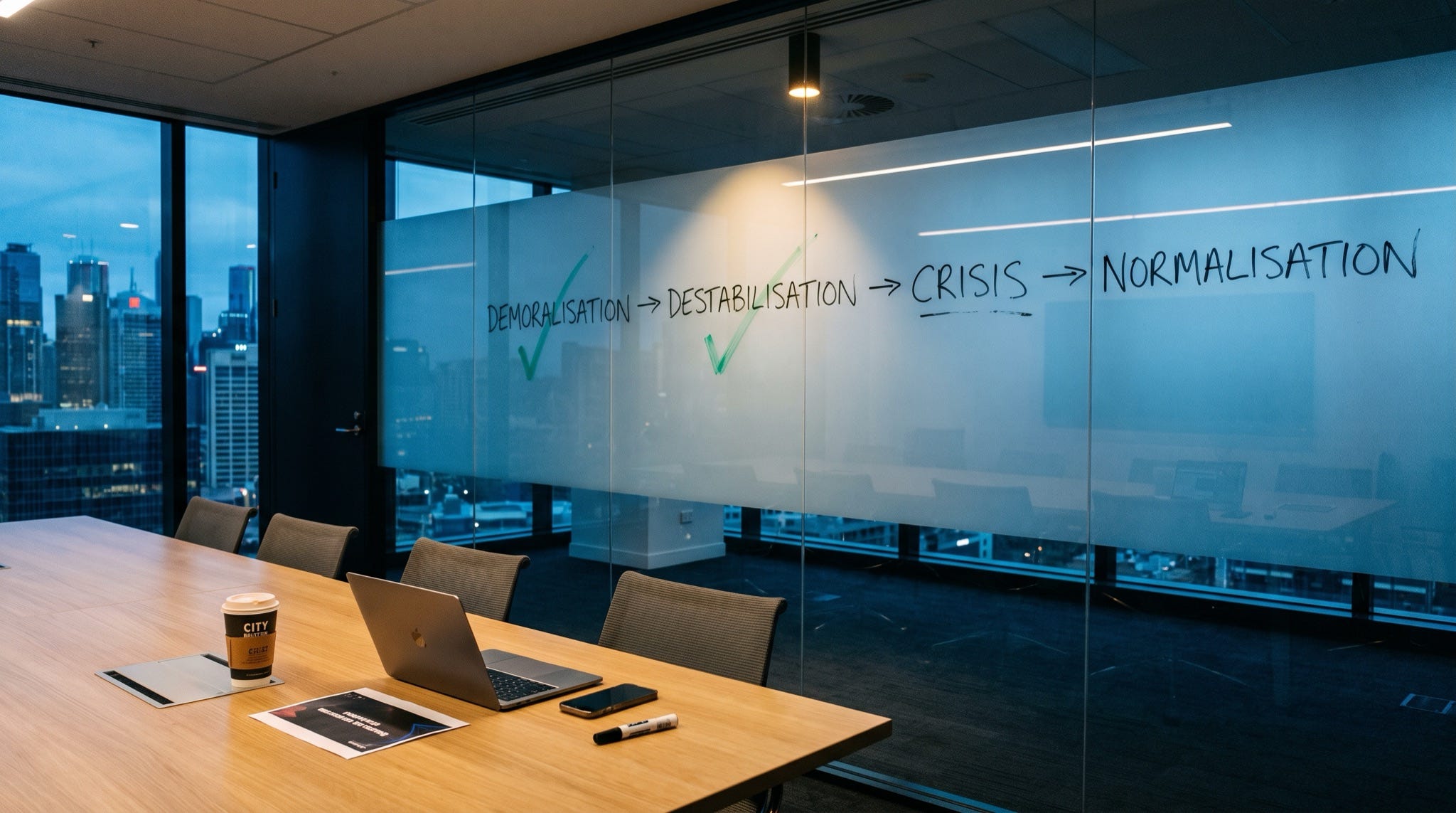
The Bezmenov Blueprint
There is a dead man whose playbook your organisation is probably following right now.
Not intentionally. Not maliciously. That is precisely what makes it so dangerous. The playbook works best when the people running it have no idea they are running it.
His name was Yuri Bezmenov. He was a KGB propagandist who defected to the West in 1970, spent the next decade and a half explaining in meticulous detail how the Soviet Union destabilised target nations from within, and then watched as almost nobody took him seriously. He died in 1993\. The world moved on. His framework did not.
Bezmenov described a four-stage process for ideological subversion. It required no military force, no invasion, no overt act of war. It was a method for rotting a society from the inside out, using its own institutions, its own contradictions, and its own complacency as the primary weapons. The stages were sequential, escalating, and largely invisible until it was too late to reverse them without significant pain.
Here is the part that should keep you awake tonight: the pattern he described maps with uncomfortable precision onto the way organisations are destroyed from within.
Not by competitors. Not by market shifts. By their own leadership.
The Four Stages
Bezmenov's model had four phases. Each one built on the last. Each one made the next one easier.
Demoralisation. This was the long game. Fifteen to twenty years of systematically eroding a society's values, beliefs, and sense of shared purpose. It was done primarily through education and media, not through force. The goal was not to create opposition but something far more corrosive: indifference. A demoralised population does not fight back. It shrugs. It stops believing that anything it does matters, that any principle is worth defending, that the people in charge are operating in good faith. Bezmenov was blunt about this stage. He said a demoralised person could be shown evidence, shown proof, shown the truth standing directly in front of them, and they would refuse to act on it until the consequences landed on them personally. By then, of course, it would be too late.
Destabilisation. Once the moral and intellectual foundations were compromised, the structures followed. This phase was faster. Two to five years. The targets were the economy, defence, foreign relations, and the institutional architecture that held the nation together. Destabilisation did not require destroying these systems outright. It only required making them unreliable. Inconsistent. Contradictory. When people can no longer trust the structures around them to function predictably, they stop investing in those structures. They protect themselves. Cooperation collapses. The centre does not hold because nobody believes the centre exists anymore.
Crisis. The breaking point. Weeks to months. A destabilised system does not need a catastrophic external event to enter crisis. It only needs a trigger. Something that would be manageable under normal conditions becomes existential because the foundations have already been hollowed out. The system cannot absorb the shock because there is nothing left to absorb it with. Crisis creates urgency, and urgency demands change, and the nature of that change depends entirely on what was built, or destroyed, in the preceding stages.
Normalisation. The cruellest stage. After the crisis passes, a new reality is imposed. It may bear no resemblance to what existed before. It may be demonstrably worse by every measurable standard. It does not matter. The population accepts it because they are exhausted, because they have no frame of reference for what "normal" used to mean, and because resistance feels pointless. Normalisation is not stability. It is resignation dressed as acceptance.
That is the sequence. Demoralisation, destabilisation, crisis, normalisation. A method refined over decades by people whose explicit profession was the destruction of functioning societies.
The Soviet Union dissolved in 1991\. Bezmenov's framework did not. He was explicit on this point: the process, once embedded, no longer requires external management. The target does the work itself. More than three decades later, the pattern is visible across Western institutions for anyone willing to look. The infrastructure changed. The playbook did not.
Now replace "nation" with "organisation" and read it again.
The Playbook Nobody Admits They Are Running
Every founder, CEO, and senior leader reading this will recognise at least one of those stages. Most will recognise more than one. Some will recognise all four and feel a specific, unpleasant sensation in their stomach.
The critical insight is not that bad actors are deliberately running Bezmenov's playbook inside your organisation. Some are, and they tend to be obvious in hindsight. The critical insight is that the pattern operates identically regardless of intent.
The leader who guts company values to chase a quarterly number is running the demoralisation stage. There is no version of strong leadership that does this. Short-termism dressed as pragmatism is still short-termism, and the cultural damage it inflicts compounds long after the quarter is forgotten.
The leader who restructures every six months, shifts strategic direction with each board meeting, and undermines middle management through back-channel communication is running the destabilisation stage. Not the leader who restructures once because the strategy demands it. The one who restructures constantly because they do not have a strategy. One is leadership. The other is organisational vandalism on a repeating schedule.
The leader who, when crisis arrives, defaults to blame, deflection, and panic is not revealing a momentary weakness. They are revealing the accumulated damage of every stage that came before. The crisis did not create the failure. It exposed it. No credible leadership doctrine holds up blame and deflection as acceptable crisis responses. What you see in that moment is exactly what was built.
And the leader who, in the aftermath, tells the surviving team that this is just how business works, that expectations need to be "realistic," that the new normal is simply normal: that leader is running normalisation. They are asking people to accept a diminished reality and call it maturity. They are institutionalising resignation and presenting it as wisdom.
None of these leaders think they are destroying their organisation. That is what makes the pattern so reliable. Bezmenov understood that the most effective subversion is the kind the subject performs on themselves.
The Inversion
This series is not about Bezmenov. It is about what happens when you invert his framework.
Each of his four stages has an antithesis. Not a defensive posture, not a reaction, but a deliberate act of construction that makes the corresponding stage of destruction structurally impossible.
Where demoralisation erodes belief, conviction builds it. Not slogans on a wall. Not a values statement that nobody can recite. Conviction is the operational reality of people who know what they stand for and are prepared to pay a price for it.
Where destabilisation undermines structures, stabilisation reinforces them. Not rigidity. Not resistance to change. Structural integrity with flexibility built in, so that when pressure comes, the organisation bends without breaking.
Where crisis exposes fragility, confidence demonstrates preparedness. Not optimism. Not bravado. The kind of confidence that is earned by having done the work before the pressure arrived. An organisation that has built conviction and stability does not panic when crisis hits. It performs.
Where normalisation imposes resignation, ownership creates agency. People do not passively accept the culture they inhabit. They built it. They sustain it. They evolve it. The difference between an organisation people endure and an organisation people own is the difference between Bezmenov's endgame and its opposite.
Conviction. Stabilisation. Confidence. Ownership. That is the inversion. That is what this series will examine, stage by stage, over the next five articles.
The Honest Question
Bezmenov spent the last two decades of his life trying to warn people about a pattern they could not see because they were inside it. He was largely ignored. Not because he was wrong, but because the pattern is designed to be invisible to those it affects most.
The same is true inside organisations. The people best positioned to see the demoralisation are the ones most demoralised. The people best positioned to see the destabilisation are the ones who have already been destabilised out of influence. By the time the crisis arrives, the damage is structural. By the time normalisation sets in, it feels like it was always this way.
So here is the question this series will keep returning to, and it is not rhetorical.
Which playbook is your organisation running?
Not the one you put in the investor deck. Not the one you describe at the leadership offsite. The real one. The one that shows up in what you tolerate, what you reward, what you ignore, and what you punish.
Because if you cannot answer that honestly, Bezmenov already has your number.

Next in the series: Demoralisation to Conviction. The first and longest stage, where the real damage begins, and where the real building starts.
Paul Lange advises owners, executives, and boards on the decisions that define commercial outcomes and organisational character, and on what a working board actually contributes. He has spent close to four decades across finance, technology, hospitality, professional services, and operating roles, in Europe, Asia, the Middle East, and Australia, on both sides of the table, with private equity and venture capital one part of it, and has taken five of his own companies through to exit. He is the creator of the Total QX™ and TILE Theory™ frameworks, and the author of The 20% Leader, Mis(très)s Entrepreneur Manifesto, Evolve or Be Remembered, and The Inheritance Manifesto. He runs his advisory practice, Manolutions, from the Gold Coast, Queensland. He writes Conviction because leadership without accountability is just theatre.