
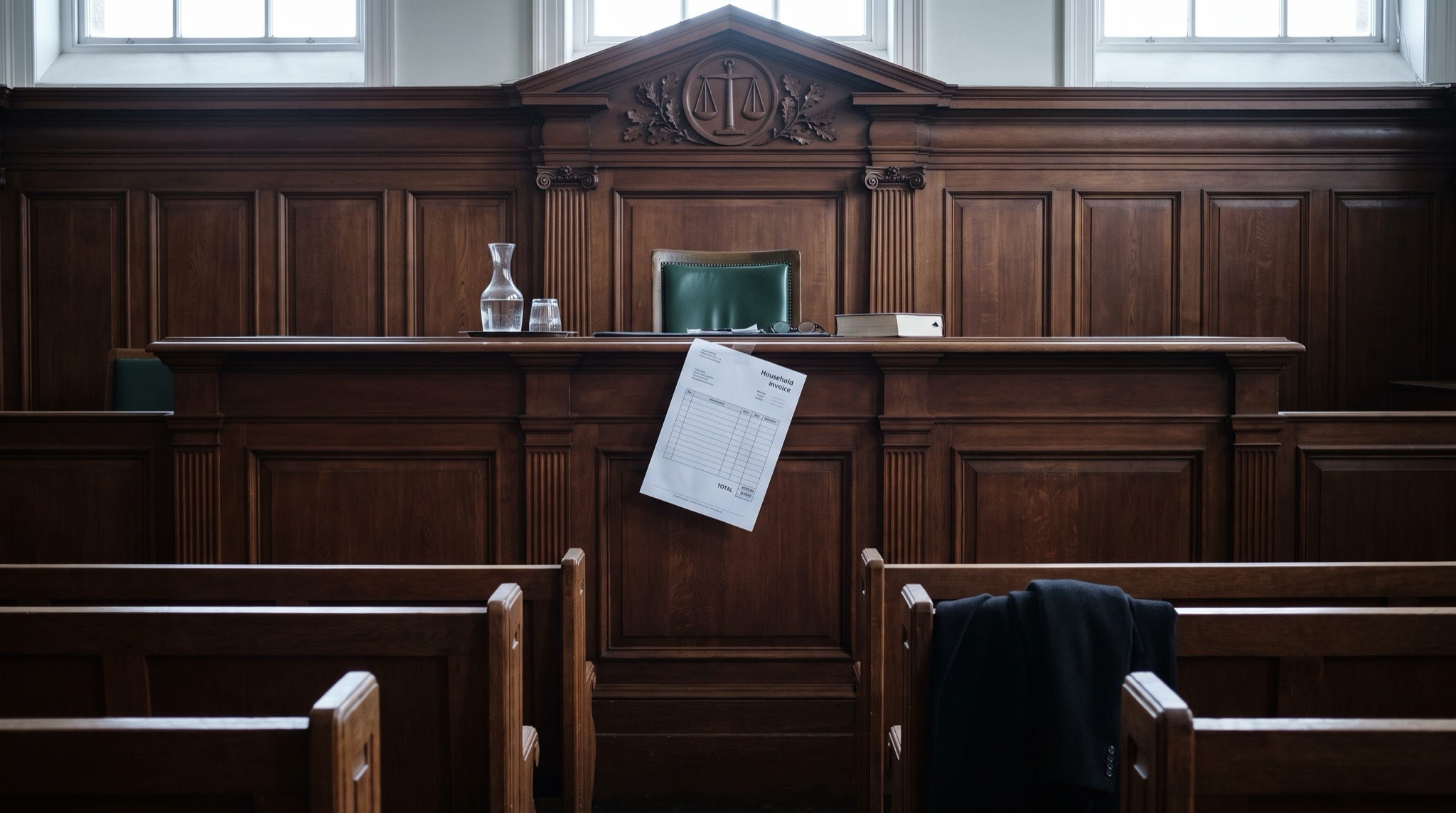
In 2022, a woman in Brisbane sat in a courtroom and watched the man who had sexually assaulted her daughter walk out on a suspended sentence. The judge cited mitigating factors. The mother cited something else entirely, though the court transcript cleaned it up. She went home that evening to explain to her fourteen-year-old that justice had been served. She could not do it with a straight face.
That judge still sits on the bench. His salary is still paid. His pension is still accruing. His decision cost him nothing.
This is the article where we talk about that.
The Protected Class
There exists a class of people in modern democracies who make decisions of enormous consequence and bear none of the cost when those decisions are wrong. Judges. Politicians. Senior bureaucrats. Regulators. Law enforcement leaders. They operate inside a structure that was designed, ostensibly, to enable good governance free from personal fear or favour. What it has actually created is a caste of decision-makers who are functionally untouchable.
In business, as a leader, your cock is on the block. Make a catastrophic call and your neck is on the block. You lose your position, your reputation, sometimes your personal wealth. The feedback loop between decision and consequence is tight. Imperfect, but tight. That loop does not exist in public office.
A politician can vote for policy that destroys livelihoods. A judge can release a violent offender who reoffends within the week. A health bureaucrat can endorse mandates that strip people of their employment for refusing a medical procedure. And when the dust settles and the damage is tallied, not one of them is made to reach into their own pocket. The bill goes to the public purse. Which means it goes to you.
The Cost of Being Wrong
Let us stay with that point because people skip past it too quickly.
When there are calls for compensation, whether for the vaccine-injured, the falsely imprisoned, or the victims of bureaucratic overreach, the money does not materialise from thin air. It comes from consolidated revenue. Tax dollars. Your dollars. The people who made the bad decisions contribute nothing beyond what they already pay as ordinary taxpayers, if they pay tax at all. At best, they contribute the same as the bloke who had no say in the decision at all.
Nobody pulls a wad of cash out of their magic arsehole without consequence. Someone always pays. And it is never the person who caused the problem.
This is not accountability. It is subsidised incompetence. And in some cases, it is subsidised corruption.
Exhibit A: The Covid Years
You do not have to dig far for evidence. The Covid scamdemic provided the most comprehensive case study in institutional failure and moral cowardice most of us will witness in a lifetime.
Politicians imposed mandates that they knew, or should have known, were disproportionate to the threat. They shut down economies, destroyed small businesses, separated families, and created a two-tier society where your right to earn a living depended on your willingness to submit to a medical intervention that was experimental by any honest definition.
People lost their jobs. People died from the vaccines. People suffered injuries that they will carry for life. And the architects of those mandates? They are still in office, still drawing their pensions, still appearing on panels talking about "lessons learned." Some of them were promoted.
The media were not bystanders. They were active participants. They amplified the narrative, suppressed dissent, and character-assassinated anyone who questioned the orthodoxy. The majority of the medical profession went along with it, and while there were honourable exceptions, most doctors decided that their holiday homes and their new luxury cars were worth more than their Hippocratic obligations. This is not conjecture. The evidence has been rolling in from multiple directions, through freedom of information requests, whistleblower testimony, and the slow drip of data that the institutions tried to bury under seventy-five years of classification.
And now there are calls for compensation for the vaccine-injured. Good. They deserve it. But from whom? Not from the public purse. Not from you and me. From the people who mandated it, endorsed it, profited from it, and suppressed anyone who raised the alarm. And let’s be honest, the vaccine injured should be, at best, second in line. Any compensation should first go to the people who stood their ground against the tyranny and were fired for refusing the jab mandate. The injured either believed the bullshit or did not have the backbone to stand against it… some simply because they wanted to be able to go to the pub.
The Corporate Wing
Do not make the mistake of thinking this is limited to government. The corporate world has its own version of the same disease.
Alan Joyce, the former CEO of Qantas, is the textbook example. An Irish transplant who ran Australia's national carrier with the warmth and empathy of a parking meter. During the pandemic, he forced vaccine mandates on his staff, sacked workers who refused to comply, outsourced ground handling to cut costs (and then presided over a baggage handling catastrophe), and fed enthusiastically at the trough of public money that governments shovelled toward airlines to keep them airborne.
When it all caught up with him, he walked away. Not to a modest retirement of quiet reflection, but to a multi-million dollar harbourside apartment in Sydney to enjoy the view of Circular Quay with his boyfriend/partner. His personal wealth was not diminished by the damage he caused. The airline's shareholders, employees and Australian taxpayers absorbed the cost.
Mark Zuckerberg censored dissenting views on his platform at the behest of government agencies, something he has since admitted to in writing. Jack Dorsey did the same at Twitter, and somehow managed to cultivate an image as a free-thinking tech sage while running one of the most aggressive censorship operations in digital history. Google suppressed search results. Oracle profited from the data infrastructure. None of them were held personally accountable.
The pattern is consistent. At the level where decisions have the greatest impact on the greatest number of people, the decision-makers are insulated from the consequences of getting it wrong, or in many cases, of getting it deliberately and profitably wrong.
The Proposal
So here is the thought experiment that ought to keep every person in public office awake at night, but does not, because the current system is designed to ensure they sleep very well indeed.
What if personal liability applied?
Not criminal liability in the narrow legal sense, though that would be a start. Personal financial liability. What if a judge who released a violent offender who went on to reoffend had to contribute to the victim's compensation from his own assets? What if a politician who voted for a mandate that was later proven to be based on fraudulent data had their personal estate exposed to claims from those who were harmed? What if the bureaucrats who facilitated the policy, and the advisors who endorsed it, and the media executives who amplified it without scrutiny, all faced the prospect of personal financial consequences?
You would see a different quality of decision-making overnight.
Not because these people would suddenly develop a conscience. That ship sailed long ago for most of them. But because self-interest is the one motivation you can always rely on. If a politician knew that accepting a donation from a pharmaceutical company and then mandating that company's product could result in their personal assets (including assets buried beneath layers of Trusts and other structures) being pursued when the product turned out to be harmful, they would think twice. Not out of virtue, but out of survival.
This is how it already works in parts of the private sector. Directors of companies carry personal liability for certain decisions. Professionals carry indemnity insurance precisely because they can be sued personally. The principle exists. It is simply not applied where it matters most.
The Facilitators
And let us not forget the facilitators. Personal accountability should not stop at the person who signs the order. It should extend to everyone who enabled it.
The media outlet that ran propaganda without question. The doctor who administered a treatment they had private doubts about because the alternative was professional ostracism. The HR manager who terminated an employee for refusing a mandate. The social media executive who suppressed truthful information. Each of these people made a choice. And choices should have consequences.
"I was just following orders" was not an acceptable defence in Nuremberg and it should not be an acceptable defence in a functioning democracy. You participated in the machinery that harmed people. You had the ability to refuse or resign. You are accountable. Not as much as the person who gave the order. But accountable nonetheless.
The Objection
The obvious counterargument is that personal liability would paralyse decision-making. That no one would accept a position of authority if their personal wealth were at risk. That it would make governance impossible.
Good.
If the only thing preventing paralysis is the guarantee that you will never personally suffer for your mistakes, then you are not a leader. You are a gambler playing with someone else's money. And we have too many of those already.
The objection also assumes that we need the same people making these decisions. We do not. If personal liability removed every careerist politician, every compromised judge, and every compliant bureaucrat from public life, the vacuum would be filled by people who take the job seriously precisely because the stakes are real. Which is the entire point.
The Real Question
In the end, this is not about vengeance. It is about alignment. The simplest principle in leadership, in business, in life, is that the person making the decision should carry a proportionate share of the risk that comes with being wrong. We accept this principle in every domain except the ones where decisions affect the most people.
That mother in Brisbane understood something the system does not want you to understand. The immunity of the incompetent is not a flaw in the system. It is the system. And until the people who make decisions that shape your life have something personal to lose when they get it wrong, nothing will change.
It will not change because the people who benefit from the current arrangement are the same people who would need to vote to change it. And turkeys do not vote for Christmas.
So perhaps the real question is not whether these people should be held personally accountable. Of course they should. The real question is what the rest of us are prepared to do about the fact that they are not.

Paul Lange advises owners, executives, and boards on the decisions that define commercial outcomes and organisational character, and on what a working board actually contributes. He has spent close to four decades across finance, technology, hospitality, professional services, and operating roles, in Europe, Asia, the Middle East, and Australia, on both sides of the table, with private equity and venture capital one part of it, and has taken five of his own companies through to exit. He is the creator of the Total QX™ and TILE Theory™ frameworks, and the author of The 20% Leader, Mis(très)s Entrepreneur Manifesto, Evolve or Be Remembered, and The Inheritance Manifesto. He runs his advisory practice, Manolutions, from the Gold Coast, Queensland. He writes Conviction because leadership without accountability is just theatre.