
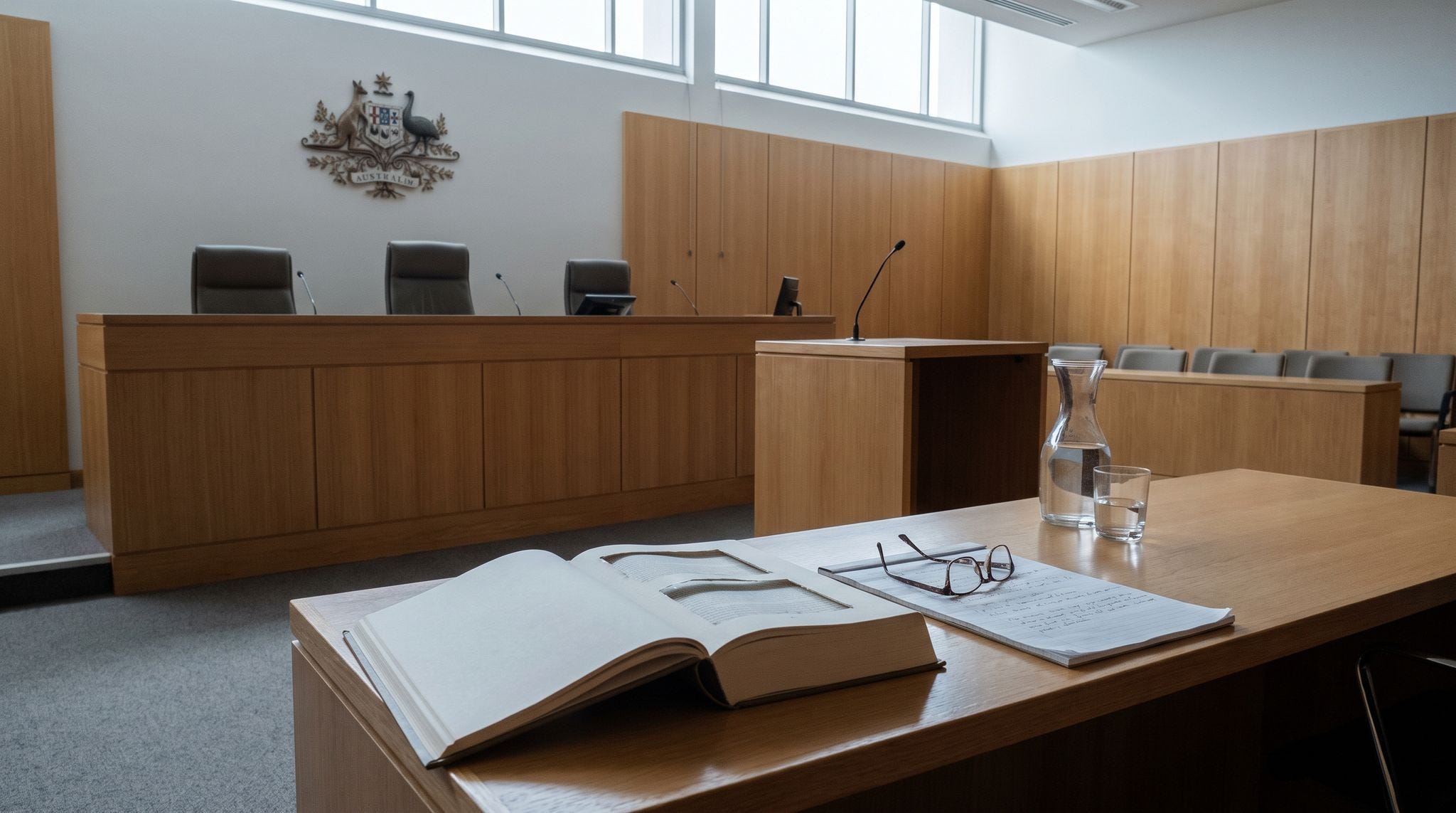
A woman is an adult human female. A man is an adult human male. Sex is binary, observable at birth, and immutable in every meaningful sense. None of those statements were contested in any Australian institution within living memory. All three are now, in 2026, contested by Australian law. Start with that sentence. The rest of this article is about how we got here, which institutions allowed it, and the one woman who has spent five years and more than a hundred thousand dollars refusing to pretend otherwise.
On Friday 15 May 2026, the Full Court of the Federal Court of Australia (Perry J, Abraham J, Kennett J) handed down its decision in Giggle for Girls Pty Ltd v Tickle [2026] FCAFC 64 (Giggle v Tickle). Sall Grover, founder of Giggle for Girls, lost her appeal. The court went further. It allowed Tickle's cross-appeal, reclassified the discrimination from indirect to direct, doubled the damages from ten thousand dollars to twenty thousand, and added aggravating-damages reasoning that should embarrass every lawyer in the country. Grover and the company were ordered to pay Tickle's legal costs up to a hundred thousand dollars on top.
In plain English: a woman built a social network for women, removed a biological male from it, and has been ordered by the Federal Court of Australia to pay him for the privilege.
Sall Grover built Giggle for Girls in response to behaviour no person should have to tolerate. She wanted somewhere women could talk to women without that risk in the room. The product was a women-only space. By definition, that meant no men in it. She wrote the AI verification herself, calibrated to ninety-four per cent accuracy on biological sex. The app launched, gained users, and in September 2021 her verification flagged a profile photograph as male. She acted on the flag. The user removed was Roxanne Tickle, then 57, a biological male in possession of a Queensland birth certificate reissued as female following surgical reassignment.
Tickle filed a complaint. Conciliation failed. He sued. He won at trial in August 2024. He cross-appealed for higher damages. He won again on appeal. He successfully sought aggravated damages partly on the basis that Grover had used male pronouns during her own legal defence, in a proceeding where the central question was whether Tickle was legally a woman. Read that twice. The defence to a discrimination claim brought on the question of whether someone is female was punished, in damages, for not conceding the question. The trial judge had refused to award damages on this point, observing reasonably that there must be scope for litigants to put forward their case. The Full Court overturned him.
Pick your explanation for Tickle's conduct. Three are available. The first is ideological. A man genuinely believes himself a woman in some deep and unfalsifiable sense and uses the law to compel everyone around him to ratify the belief. The second is opportunistic. A man sees an open legal door in a poorly drafted statute and walks through it for damages, legal costs, and public attention. The third is clinical. The behaviour is symptomatic. None of the three exculpates the conduct. A 57-year-old man weaponising a discrimination statute against a woman who built a refuge for women is, on any of those readings, not a victim. He is the aggressor. The court rewarded him for it.
That is the foreground. The background is where the real story lives, because Tickle did not write the law. Australian Parliament did. And the institutional fingerprints on this verdict belong to every Prime Minister, every Attorney-General, and every party room since 2013.
The Sex Discrimination Act 1984 (Cth) was passed by the Hawke government to implement Australia's obligations under the UN Convention on the Elimination of All Forms of Discrimination Against Women. CEDAW is, on its face and in its substance, a treaty about biological women. It addresses pregnancy, maternity, lactation, and the physical realities of being female. It does not address gender identity. It could not have. The concept did not exist in its modern form when CEDAW was drafted. The original SDA reflected that. It contained workable definitions of "man" and "woman" and a clear understanding of who it was protecting and why.
In 2013, the Gillard Labor government changed that. The Sex Discrimination Amendment (Sexual Orientation, Gender Identity and Intersex Status) Act 2013 introduced new protected categories (sexual orientation, gender identity, intersex status, relationship status) and quietly removed the definitions of "man" and "woman" from the parent Act. Anna Cody, the current Sex Discrimination Commissioner, has since confirmed under questioning by Senator Malcolm Roberts that "man," "woman," and "sex" are now nowhere defined in the law. Read that twice as well. The Sex Discrimination Act does not define sex.
Watch the timing on the 2013 amendments.
Julia Gillard became Prime Minister on 24 June 2010 after deposing Kevin Rudd in caucus. She called an election within weeks, won a hung parliament, and governed through Greens and independent support. Her tenure was three years and two days. The Sex Discrimination Amendment Bill cleared Parliament on 25 June 2013. She was removed by Rudd in a return caucus ballot on 26 June 2013. The bill received royal assent on 28 June 2013. The numbers are not a coincidence. The legislation that stripped "woman" out of the Sex Discrimination Act was rammed through Parliament in the final forty-eight hours of a government that everyone in Canberra knew was about to fall.
This is the woman whose career rhetorical signature was the misogyny speech. The woman who built an identity on protecting women from men. The single most consequential legislative act of her three-year prime ministership, on the question of women, removed women from the law that protects them. Three years in the Lodge. That is what she left women.
The Coalition's hands are no cleaner. Under Tony Abbott's opposition leadership, the Liberal-Nationals voted in favour of the 2013 amendments. They did not stand against. They did not even abstain. They waved them through. Then the Coalition won the September 2013 election and held government for the next eight years and eight months. Three Prime Ministers (Abbott, Turnbull, Morrison). Three Attorneys-General. Nine federal budgets. Three full terms of parliamentary majority. Not one move to restore the definitions of "man" and "woman" to the Sex Discrimination Act.
Both parties produced this outcome. This is what people mean when they call Australian federal politics a uni-party. Not that Labor and the Coalition are identical on every issue. The argument is that on the institutional questions that actually shape the country (definitions, sovereignty, central bank policy, immigration architecture, the operational reality of who has rights and who does not) the differences collapse to rhetoric. Labor wrote the law that produced this verdict. The Coalition voted for it. The Coalition then had nine years to fix it and did not. Both parties have spent the thirteen years since pretending the consequences would never arrive at a courtroom. They arrived on 15 May. The Tickle verdict is bipartisan property.
The institutional list is longer than two parties. The Australian Human Rights Commission intervened in the case on Tickle's side. The Sex Discrimination Commissioner, whose statutory role is to protect women, took the position in court that a biological male can be a woman in law. Several state human-rights apparatuses have been pushing the same direction for a decade. The Federal Court has now, on appeal, layered judicial overreach on top of legislative cowardice. Two of the three appeal judges observed in obiter (the dangerous bit, the bit not strictly necessary to decide the case) that ordinary contemporary usage may now accept a man who has adopted female social presentation, but who has not undergone surgery, as a "woman." There is no parliamentary act supporting that view. There is no High Court decision supporting it. They wrote it anyway. It now hangs over every single-sex space in the country.
There is one more layer, and it is the layer Australians least understand. The Commonwealth Parliament has no direct constitutional power to legislate on discrimination. The Constitution gives that authority to the states. The Commonwealth gets there only by tethering itself to an international treaty under the external affairs power at section 51(xxix). The original SDA was tethered to CEDAW, and that tethering was solid because CEDAW is about biological women.
The 2013 amendments are tethered to the International Covenant on Civil and Political Rights (1966) and to its "other status" provision on discrimination. That provision says nothing about gender identity. In 1966, when the Covenant was opened for signature, the concept of "gender identity" as the 2013 amendments define it did not exist. The constitutional argument for the 2013 amendments rests on what international lawyers call evolutionary or progressive treaty interpretation. Treaty terms, on this theory, do not mean what their signatories intended in the year of signing. They mean what international human-rights bodies decide they mean over time.
I want to be precise about what this means for Australian sovereignty, because it is too easily dismissed as conspiracy talk. It is not conspiracy. It is constitutional architecture.
A federal parliament that has no independent power to legislate on discrimination must hook each new piece of discrimination law to a UN treaty. Once hooked, the meaning of that law is no longer a matter for Australian voters, Australian parliamentarians, or Australian courts on their own terms. The meaning drifts with international consensus. When a Geneva committee or an academic working group reinterprets "other status" to include a category invented in the 1990s, that reinterpretation flows back into Australian domestic law. The Full Federal Court did exactly this last week. It reached for "ordinary contemporary usage" to fill the definitional vacuum left by Parliament. Ordinary contemporary usage according to whom? Not Australians voting on anything. Not Parliament debating anything. The contemporary international class of human-rights jurisprudence. That is who.
This is not an isolationist argument. It is a sovereignty argument. Australia has the resources, the people, and the institutional know-how to govern itself on the questions that define life inside its borders. What we have lacked is the political will to insist on it. The external affairs power has been used to do work the Australian people never voted for and have no direct mechanism to override. The High Court has signed off on this expansion repeatedly since the Tasmanian Dam Case in 1983. Both major parties have used the device. Neither has had the courage to acknowledge the cost.
The cost is what landed in the Federal Court on Friday. A woman cannot run a women-only business in Australia in 2026 because the definition of "woman" in the relevant statute is being read off international interpretive drift rather than off biology or off any clear domestic political mandate. We have sovereignty in name. In practice on questions of this kind, we have outsourced it.
Contrast this with the United Kingdom. In April 2025 the UK Supreme Court ruled unanimously in For Women Scotland Ltd v The Scottish Ministers [2025] UKSC 16 that "sex" in UK equality law means biological sex. The judgment is detailed, reasoned, and binding. Two top-tier Anglosphere courts looking at materially similar statutory questions within a twelve-month window. One did the work and held the line. The other reached for "ordinary contemporary usage," ignored the UK precedent almost entirely (a single peripheral reference across the whole judgment), and doubled the damages against the woman defending the position the UK Supreme Court had just upheld. That is a national failure. It is one I do not expect to see corrected by the institutions responsible for it.
Which brings me to the people who have not failed.
Sall Grover built a product. She held a standard. She was sued. She defended. She lost at trial. She appealed. She lost again. She has indicated she will appeal to the High Court. She has shut down the app, absorbed years of her life and over a hundred thousand dollars of legal exposure, and has not at any point conceded the central proposition. She has said in court, in interviews, and on the day of the verdict the same thing she said five years ago: a man is not a woman. The state of Australian institutional life is such that this is now a brave statement. It should not be. It is the position of every honest biologist on earth.
In the language of my own work, Grover is a Standards Sniper™. She identified the standard, she set it, she defended it under pressure, and she did not move when the institutional weight came down on her. Many of the senior people I know in corporate Australia, and many more I watch from a distance, are busy adding pronouns to email signatures and running gender-identity training modules drafted by people who have never built anything. One woman on the Gold Coast built a thing, defended it, and paid for it personally. The contrast does not require commentary. It is its own commentary.
Alongside Grover, Rachael Wong deserves naming. Wong is the CEO of Women's Forum Australia, a former lawyer with international policy reform experience, and the most consistent public voice on this case in Australian media since 2023. She attended the original three-day Federal Court hearing in April 2024 in person. She has been on Sky News through Bernardi, Bond, and Credlin. She wrote the analysis piece on the case that international observers have been quoting since. She was the first public commentator to argue the constitutional-overreach point and the first to call the appeal verdict what it is. After the Full Court handed down on Friday, Wong called Australia "the laughing stock of the world." She is correct. While various corporate ambassadors-for-women collected awards and gave speeches over the last five years, Wong was in the courtroom, on the screen, and on the record. That is what advocacy actually looks like.
There will be more women named in this list over the coming year. Senator Pauline Hanson has been on this point for years. Nationals MP Alison Penfold is preparing a private member's bill. Senator Alex Antic flagged the same intention back in July 2025. None of them sit on the front bench of either major party. They are the back-bench remnant in a Parliament that has otherwise spent thirteen years pretending the question would not need answering.
The verdict last Friday is two verdicts.
The narrow one runs against Sall Grover. Twenty thousand dollars, costs to a hundred thousand, the closure of her business, and five years of her life.
The wider one runs against the institutions. Against the Parliament that wrote bad law in 2013 and let it sit unchanged. Against the Coalition that voted for it in opposition and refused to touch it in three terms of government. Against the Sex Discrimination Commissioner whose office argued against women in a women's case. Against the human-rights apparatus that helped fund and intervene. Against the Federal Court that filled a definitional vacuum with obiter rather than sending it back to Parliament where it belonged. Against thirteen years of Australian political class who knew exactly what they had done and lacked the courage to undo it.
Conviction in this newsletter is meant in both its senses. Belief held under pressure. And the verdict that follows institutional failure. Friday's verdict delivered both. One woman on the Gold Coast has the first. The institutions of Australian law have earned the second.

Paul Lange advises owners, executives, and boards on the decisions that define commercial outcomes and organisational character, and on what a working board actually contributes. He has spent close to four decades across finance, technology, hospitality, professional services, and operating roles, in Europe, Asia, the Middle East, and Australia, on both sides of the table, with private equity and venture capital one part of it, and has taken five of his own companies through to exit. He is the creator of the Total QX™ and TILE Theory™ frameworks, and the author of The 20% Leader, Mis(très)s Entrepreneur Manifesto, Evolve or Be Remembered, and The Inheritance Manifesto. He runs his advisory practice, Manolutions, from the Gold Coast, Queensland. He writes Conviction because leadership without accountability is just theatre.