
This week's Conviction was meant to be a non-political piece, and that article is still coming. I'll publish it on Monday. But when the European Parliament passes a landmark migration bill by nearly two to one and half the hemicycle stands up and cheers, that's not something you sit on until next week. Some things need to be said while they're still warm. This is one of them.
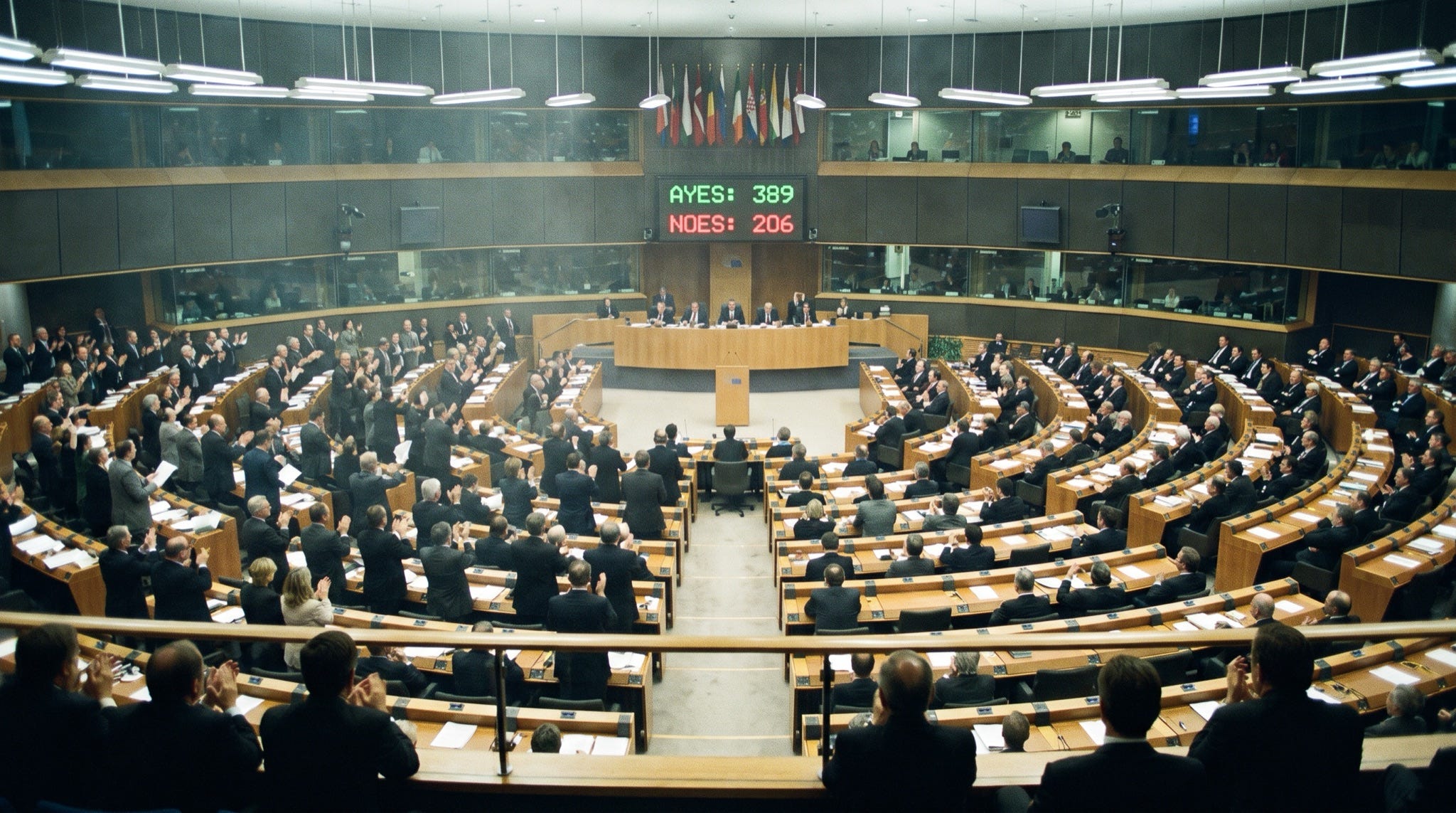
On 26th March 2026, the European Parliament voted 389 to 206 to approve a proposal for a law that would speed up reimigration/the return of irregular migrants, allow the construction of deportation centres outside the EU, extend detention periods to two years, and impose what amounts to permanent re-entry bans.
The hemicycle erupted in applause.
Good. It's about time.
This is what happens when enough people stop being polite and start being honest about what mass irregular migration actually does to a society. It destabilises national identity. It stretches public services past breaking point. It erodes social cohesion. And it makes citizens feel like strangers in their own countries.
For years, much of the West has been governed by people who wanted the language of sovereignty without the burden of exercising it. They wanted borders in theory, loopholes in practice, and applause for calling that balance.
It was never balance. It was weakness dressed up as virtue.
A state has one duty before all the fashionable language gets piled on top of it. It must preserve order, enforce its laws, and steward the continuity of the nation it was entrusted to govern. If it cannot correctly decide who may enter, who may stay, and who must leave when they have no lawful basis to remain, then it is not governing. It is managing decline with better press releases.
The EU's new "return regulation" is the legislative cornerstone of a continent finally waking up. It enables member states to return irregular migrants to third countries (not just their countries of origin) through bilateral agreements and purpose-built return hubs. Families with children are included. Appeals no longer automatically suspend deportation. And there's now a provision for engaging with "non-recognised third country entities" for readmission, which is Brussels-speak for doing whatever it takes to get people back where they came from.
The Greens are predictably horrified. One MEP called it "a total renouncement of EU values." With respect, the actual renouncement of EU values has been happening for decades … the unchecked flow of people with no legal right to be there, the erosion of borders, the quiet surrender of sovereignty dressed up as compassion.
This is a leadership issue before it is a policy detail.
What has weakened Western countries is not simply migration pressure. It is leadership failure. The chronic, institutional refusal to say that a country has a right to remain coherent. The fear (especially among mainstream politicians) of being called harsh for doing the very job they were elected to do.
That fear has paralysed governments for years.
And here is what makes it so dangerous: weak leadership does not always look like chaos. Often it looks polished. Humane. Measured. Responsible. It cloaks dereliction in the language of decency. It presents refusal to act as moral maturity. It calls drift compassion and expects the public to applaud while the underlying conditions worsen.
When a government will not enforce a basic distinction between lawful presence and unlawful presence, it trains the public to stop believing in the seriousness of the whole system. And once that happens, distrust does not stay neatly confined to migration. It spreads. Into dwindling confidence in institutions. Into dwindling confidence in the courts. Into dwindling confidence in the administrative state. Into dwindling confidence in the decaying political class itself.
Then the same people who failed to enforce reality act shocked when voters stop listening to them.
They should not be shocked. They caused it.
In business, everyone understands this. A leader who sets standards but refuses to enforce them destroys the standards. A board that avoids difficult calls to protect its own self-image weakens the institution it claims to serve. A CEO who keeps explaining away obvious operational failure is not being nuanced. He is choosing narrative over reality.
States are no different.
If the law says one thing and practice says another, practice wins. If removal orders are issued but not enforced, the system is lying. If politicians keep pretending this can be fixed with softer language, better framing, and more sensitivity training for the public, they are not leaders. They are stewards of decay.
Credit where it's due. This shift in Europe didn't come from the political establishment. It came from parties like the AfD in Germany, Geert Wilders' PVV in the Netherlands, and Reform UK. These are the parties that said what millions of citizens were thinking while the mainstream called them extremists. The European People's Party (the so-called mainstream conservatives) only got on board because the ground shifted beneath them. They aligned with the right to pass this bill because they had no choice. The electorate demanded it.
That's leadership from the outside in. And it worked.
But let's be clear: this is step one, not the finish line.
The bill now moves to negotiation between Parliament and member states. The expectation is that this will be smooth — the two texts are broadly aligned. Good. Get it done. Get it into law. No watering down, no delay, no hand-wringing.
The Parliament's move is important not because it is perfect but because it breaks the spell. It admits that a migration system which cannot remove people with no legal right to remain is not a system. It is an invitation. And it admits something else the centre has resisted for too long: states that refuse to enforce boundaries do not become more respected. They become less credible.
And then other nations must follow.
Australia is already moving, albeit with the usual political contortions. The Albanese Government has passed the Migration Amendment (2026 Measures No. 1) Act, which includes third-country deportation provisions and a new Nauru deal worth over $2.5 billion across 30 years. They've introduced arrival control determinations (the first targeting Iranian visitor visa holders … no surprise there given the Zionist grip on power in this country and others through money and media control) and expanded ministerial powers to reverse protection findings and enforce removal directions.
It's progress. But it's not enough, and everyone knows it.
Australia needs to stop treating border control as a crisis response and start treating it as a permanent structural priority. Not a talking point at election time. A standing policy with teeth, funding, and no apologies.
Every Western nation does.
People belong in their countries. Not as a punishment. As a principle. Every nation has a right to decide who enters, who stays, and who leaves. Every nation has a responsibility to its own citizens first. And every person born somewhere carries a responsibility to steward the place they came from, not abandon it for someone else's prosperity, and then try to mould it into a version of their place of origin.
The EU Parliament just took a meaningful step. The AfD and parties like it deserve credit for making that step politically possible.
Now get it across the line. And for the rest of the Western world (Australia included) the mandate is not to consider, not to explore, not to consult.
It's to act.
Because a country that will not remove those with no legal right to remain is telling the world something catastrophic about itself. It is saying that its laws are optional, its borders are negotiable, and its leadership is afraid to lead.
A state that will not enforce its own boundaries is not being humane. It is abandoning its duty.

Paul Lange advises owners, executives, and boards on the decisions that define commercial outcomes and organisational character, and on what a working board actually contributes. He has spent close to four decades across finance, technology, hospitality, professional services, and operating roles, in Europe, Asia, the Middle East, and Australia, on both sides of the table, with private equity and venture capital one part of it, and has taken five of his own companies through to exit. He is the creator of the Total QX™ and TILE Theory™ frameworks, and the author of The 20% Leader, Mis(très)s Entrepreneur Manifesto, Evolve or Be Remembered, and The Inheritance Manifesto. He runs his advisory practice, Manolutions, from the Gold Coast, Queensland. He writes Conviction because leadership without accountability is just theatre.