
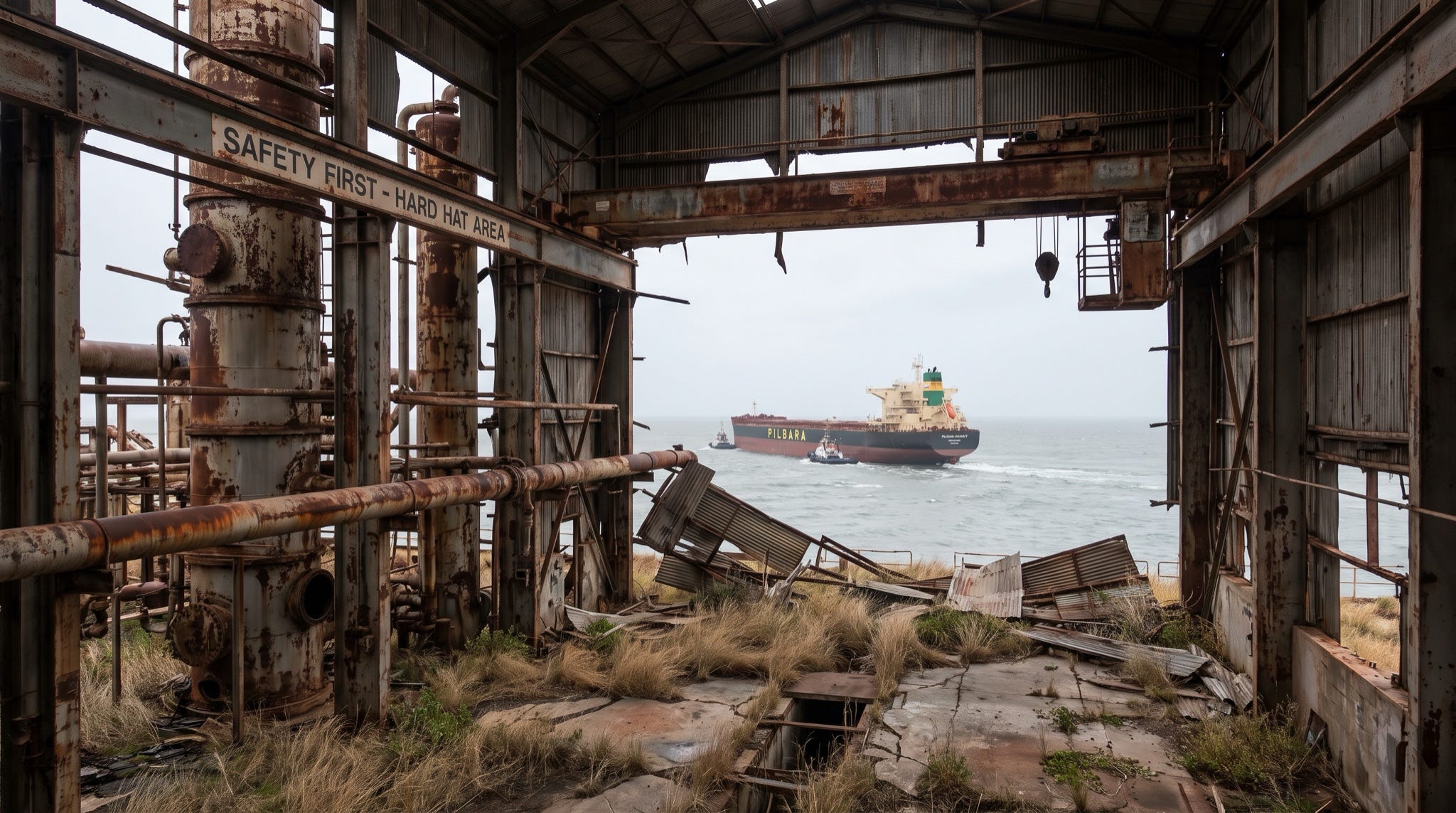
There is a question circulating on social media right now, dressed up in working-class outrage and delivered over a montage of iron ore trains and diesel trucks. It goes roughly like this: if this country is so rich, why does it feel like everyone is getting poorer?
It is a good question. It deserves a serious answer rather than a political talking point.
The answer is not complicated. It is, however, uncomfortable for anyone who has spent a career in government or the institutions that surround it. The answer is that Australia's leadership class, across both major parties and across five decades, made a series of deliberate choices that systematically dismantled the country's industrial base, offshored its strategic capacity, and left ordinary Australians exposed to supply chain fragility that would embarrass a competent logistics manager.
This is not misfortune. This is not globalisation happening to Australia while the adults in the room did their best. This is leadership failure at scale. It is what happens when the people elected to run a country are, in practice, running it for someone else.
The starting point matters
Australia is, by any reasonable measure, one of the most resource-endowed nations on the planet. It holds roughly 54% of global iron ore exports. It produces close to half of the world's lithium. It is the third largest LNG exporter on earth. It is the world's largest exporter of metallurgical coal and a significant exporter of wheat, beef, and grain to Asia and the Middle East.
Ships leave Australian ports loaded with the raw materials that build cities, power grids, and economies across Asia. This has been happening for decades.
The wealth is real. The export receipts are real. The question worth sitting with is where that wealth goes, and what industrial infrastructure, resilience, or strategic depth has been built with it.
The answer is: not much. And this was not accidental.
The Lima Declaration, the Whitlam Problem and What Followed
In 1975, Australia participated in the United Nations Industrial Development Organisation conference in Lima, Peru. The resulting declaration called on developed nations to support the industrialisation of developing countries, largely by opening their markets and progressively dismantling their own infrastructure and shifting manufacturing capacity offshore. The declaration was not legally binding. No nation was compelled to do anything.
Which makes what followed all the more instructive.
To understand why Australia's political leadership acquiesced so completely to a framework that served foreign commercial and geopolitical interests at the direct expense of Australian workers and industrial sovereignty, you need to understand the political climate in which it happened, and what was being done to the man at the centre of it.
Gough Whitlam arrived as Prime Minister in 1972 with an agenda that made certain powerful interests extremely uncomfortable. He intended to withdraw Australian troops from Vietnam. He had begun asking direct questions about Pine Gap, the (originally anything but truly) joint US-Australian signals intelligence facility in the Northern Territory, including who was running it and what it was actually being used for. He had taken an "even-handed" position on the 1973 Yom Kippur War rather than the reflexive pro-Israel stance his predecessors had maintained; a position that generated what he himself later described, in his 1985 autobiography, as "the crude blackmail of spokesmen and letter writers from the Jewish community." Following his 1975 dismissal, he reportedly told Iraqi officials that "Jewish pressures" on his government had been "enormous."
Whether you read those statements as the honest observations of a man under coordinated political attack, or as evidence of something more troubling about his own views, the documented reality is this: Whitlam was in active conflict with the American intelligence establishment, the pro-Israel lobby, and the foreign policy consensus of the Anglo-American world simultaneously. For all of his failings, and we all have them, he started out, in fact, a brave man.
What happened next has been debated seriously by historians ever since. The documented CIA concern about Whitlam is not in dispute. The cables are on record. The agency regarded him as a destabilising force in a strategically critical intelligence partnership. Christopher Boyce (the American intelligence operative whose story became The Falcon and the Snowman) stated publicly that the CIA was actively working to remove Whitlam from office. There are also longstanding claims (unverified and contested) that visits to Pine Gap by Whitlam, both as opposition leader in the late 1960s and as Prime Minister, exposed him to psychological influence techniques not entirely unlike those documented in the CIA's MK Ultra programme. Whether those claims reflect reality or represent the kind of story that attaches itself to any sufficiently controversial political removal is something each reader will need to assess for themselves.
What is not contested is that the man who entered office intending to challenge the existing order left it (via the Governor-General's extraordinary dismissal in November 1975) a substantially diminished political force. John Perkins, in Confessions of an Economic Hit Man, described a playbook applied repeatedly across the developing world: identify a nation with significant natural resources, cultivate or install a leadership class oriented toward foreign commercial and financial interests, open the economy to external exploitation, and ensure the domestic population never accumulates enough industrial capacity or strategic resilience to push back. The playbook does not require jungles or military coups. It works just as well in suits, in senate chambers, and in the boardrooms of international financial institutions.
Australia in 1975 is a reasonably clean illustration of the pattern. The leader who asked inconvenient questions was removed. And what followed confirmed everything.
That is precisely the point.
Over the next forty years, a sustained, bipartisan policy programme achieved voluntarily what no treaty could have demanded. Tariffs were progressively removed. Trade agreements were signed that systematically favoured import competition over domestic production. Car manufacturing was allowed to die. Steel making was left to wither. Fuel refining, once served by eight refineries across the country, was wound back to two.
None of this required coercion. It required a political class that had decided, collectively and quietly, that the old model of building things in Australia was no longer the project. The new model was to dig things out of the ground, sell them raw, and import the finished goods back from the countries that had been given the manufacturing capacity in the first place.
That is a coherent commercial strategy if your job is to serve the interests of multinational commodity traders and the global financial institutions that fund them. It is not a coherent strategy if your job is to build a resilient, self-sufficient nation with a high standard of living for its citizens.
The people who made these choices were not stupid. They knew what they were doing. The question of who they were doing it for has never been answered satisfactorily.
What it looks like in practice
Australia currently holds approximately 30 days of diesel in onshore reserve. It has been non-compliant with the International Energy Agency's 90-day reserve requirement since 2012, and has held that distinction longer than any other IEA member. It imports roughly 90% of its refined fuel, predominantly from South Korea, Singapore, Malaysia, and Taiwan.
Everything in this country that moves, grows, mines, or ships runs on diesel. The trucks, the trains, the agricultural equipment, the mining fleet. If the supply chain is disrupted for more than a few weeks, the country stops.
This is not hypothetical. As of the time this article is being written, the Strait of Hormuz is effectively closed following military action between the United States, Israel, and Iran. Fuel prices have spiked across Australia. Regional areas are experiencing shortages; at peak, over 400 service stations nationwide ran out of diesel. The government is releasing emergency reserves and temporarily relaxing fuel quality standards to add supply to the market.
And here is the detail that deserves to sit alongside that news: Australia produces its own crude oil. It exports it. It then imports approximately 90% of its refined fuel needs back from Asian refineries (primarily in South Korea, Singapore, Malaysia, and China) which in turn source 60 to 70% of their crude from the Middle East. The circular absurdity of that arrangement is not lost on anyone paying attention.
As for strategic reserves, the situation is arguably worse than it appears. There is no traditional government-controlled emergency stockpile. What Australia counts as its reserve is largely minimum stock levels held by private fuel companies (Ampol, Shell, BP, ExxonMobil, Viva Energy) under legislative obligation. Some portion of the oil counted toward Australia's international compliance obligations is stored not in Australia at all, but in Malaysia and in facilities linked to the United States Strategic Petroleum Reserve under a bilateral arrangement. The logic of storing your emergency fuel supply in another country (the same country that has a documented history of intervening in your political affairs when your government asked inconvenient questions) is left as an exercise for the reader.
In 2002, Australia held the equivalent of 310 days of fuel reserves. Today it holds roughly 30. That is not an accident of global markets. That is the outcome of a sequence of deliberate policy decisions made by people who were supposed to be managing this country's strategic interests.
A country that exports iron ore, coal, gas, and food to the world is rationing petrol.
Pause on that.
The commercial comparison
Run this same pattern through a commercial lens and ask what the outcome would be.
A company controls a large share of the world's supply of its primary product category. It earns substantial revenue from that position. Over several decades, its board and successive management teams make the following decisions: they close down the company's processing and manufacturing divisions, outsourcing those functions entirely to third parties in other jurisdictions. They eliminate most of the company's raw material storage capacity. They structure all supply chain dependencies through single-source, offshore providers. They sign trade agreements that expose the company's domestic operations to unrestricted competition from suppliers with significantly lower cost bases. They do this without any strategic resilience planning, without building alternative supply arrangements, and without meaningful consultation with the people whose livelihoods depend on the business.
The company now generates revenue from the sale of raw materials at commodity prices. Its operating resilience is near zero. It cannot produce anything domestically. It cannot function without imports. A single disruption to its supply network would halt operations within weeks.
What happens to that board?
In any functioning governance environment, they are removed. The institutional shareholders demand accountability. The chair resigns. Heads roll. An independent review is commissioned. The findings are brutal and public. Leadership is replaced with people who understand that a business exists to serve its owners and stakeholders, not to enrich its external partners at the expense of internal capability.
None of that has happened in Australia. The equivalent board has been re-elected in various configurations for fifty years. The same philosophy has been maintained across Liberal and Labor governments alike. The language changes. The substance does not.
A CEO who ran a business the way successive Australian governments have run this country would not survive a single annual general meeting. The institutional investors would have removed them long before the fuel ran out.
The accountability gap
There is a reason this parallel matters beyond rhetoric.
In a commercial organisation, the accountability structure is clear. Directors owe duties to shareholders. Management is answerable to the board. Performance is measured against outcomes. Failure has consequences. There is no hiding behind ideology or international obligations or the complexity of global forces. If the company is strategically fragile, if the supply chain is inadequately secured, if the industrial base has been gutted and the resilience has been hollowed out, the people who made those decisions are held to account.
Governments operate with no equivalent discipline. The feedback loop is a four-year election cycle in which the same two parties alternate control while maintaining, in all material respects, the same underlying policy framework. The media cycle shortens public memory. The political class cultivates a language of complexity and inevitability that deflects direct accountability. The decision that created the problem was made a decade ago by a different government and a different minister, and the trail of responsibility disperses into the institutional fog.
This is not an accident of political design. It is a feature. Diffuse accountability is extraordinarily useful if what you are doing is systematically transferring national industrial capacity and strategic sovereignty to foreign commercial interests. Nobody is responsible. Everybody had good reasons. The outcomes are no one's fault.
In a commercial enterprise, we call this governance failure. We call it a board that has been captured by interests other than those of the shareholders. We call it a leadership culture that confuses activity with accountability and consensus with competence. And when it is exposed, we act.
The question of whose interests are being served
It would be naive to reduce this to corruption in the crude sense of envelopes of cash changing hands. That is rarely how it works.
What actually happens is slower, more structural, and more durable. Industries that benefit from open markets and offshore production fund political parties, sponsor conferences, employ former ministers, and staff the advisory bodies that shape policy. The revolving door between government, the major law firms, the investment banks, and the mining and energy multinationals is not a conspiracy. It is an ecosystem. It produces a political class that is, over time, genuinely more comfortable with the interests of that ecosystem than with the interests of the tradesperson in Toowoomba who needs diesel to run his business.
This is why the Lima Declaration matters as a reference point, regardless of its legal status. Not because it was a binding instrument. Because it represents the moment Australia's political leadership class signalled, publicly and without coercion, the direction of travel. Everything that followed was a policy choice. Each refinery closure, each tariff reduction, each trade agreement was a decision made by people who had alternatives. They chose, consistently and over decades, the option that transferred Australian industrial capacity, Australian jobs, and Australian strategic sovereignty offshore.
That is a leadership failure. It is also, examined clearly, a betrayal.
What does responsible leadership actually look like?
In any organisation facing a version of this problem, the first act of competent leadership is to name it accurately. Not to explain it away, not to contextualise it into complexity, but to say: we made decisions that have left us strategically exposed, and we are going to own that and address it.
The second act is to take genuine responsibility for the consequences, even for decisions made before you arrived. Institutional leadership does not get to pick up the revenue and disclaim the liability. You inherit the balance sheet, positive and negative.
The third act is to build a plan that is oriented toward the actual interests of the people you serve. In a company, that is the shareholders. In a country, it is the people whose country this is; not the foreign nationals that have residency and not refugees hosted by the grace of our compassion. Not the mining multinationals. Not the international financial institutions. Not the foreign governments whose industrial capacity was built on the back of Australian deindustrialisation. The people.
The question that actually matters
The video doing the rounds on Instagram asks why a country this rich feels like everyone is getting poorer.
The answer is not complicated. The country is rich at the point of extraction. It is poor at the point of resilience. The wealth leaves on ships. The strategic capacity, the industrial base, the refining capability, the supply chain depth, the fuel reserves that would allow the country to function independently under pressure: those do not come back.
That is what fifty years of leadership that serves the wrong interests looks like. It looks like 30 days of diesel. It looks like two refineries where there used to be eight. It looks like a country that feeds the world but cannot guarantee it can move a truck for more than a month if the Strait of Hormuz stays closed.
Ordinary Australians are asking the right question. The leadership class has been hoping, for a long time, that not enough people would ask it loudly enough, and that the complexity of the answer would exhaust those who tried.
They miscalculated.
The ships are still leaving the ports loaded with Australian wealth. The bill for fifty years of decisions made in other people's interests is coming due. And the people who made those decisions are, as of today, still in office, still on boards, still collecting consulting fees, and still finding reasons why none of this is anyone's fault.
That is not incompetence. Incompetence is forgivable. This is something else. This is a political class that has looked at the people it was elected to serve, calculated that those people could be managed, distracted, and divided for long enough that the consequences would never fully land on anyone in particular — and has been proven right, election after election, for half a century.
They are not afraid of your vote. They have your vote. Both of them.
They are not afraid of your outrage. Outrage trends for seventy-two hours and then the algorithm moves on.
What they are afraid of — the only thing that has ever actually moved entrenched power — is organised, sustained, uncomfortable action. Not a petition. Not a hashtag. Not a protest that is permitted, policed, and forgotten by the following Monday. The kind of action that makes the current arrangement politically and personally costly for the individuals who designed and maintained it. Named. Documented. Held to account in ways that follow them out of office, off boards, and into whatever comfortable retirement they had planned.
The question is no longer why this country feels like everyone is getting poorer. That question has been answered.
The question now is whether the people to whom this country belongs are angry enough, organised enough, and serious enough to do something about it that actually hurts.
If you’re serious … what actually hurts!
Vague populist anger is the political class's best friend. It trends for seventy-two hours, generates no lasting consequences for any named individual, and dissipates without trace. They have been managing it for fifty years. They are very good at it.
What they are considerably less equipped to handle is specific, sustained, personal pressure applied through lawful means to named individuals rather than to the comfortable abstraction of "the system." The system has no career to damage. The system does not sit on boards, collect consulting fees, or worry about its legacy. People do.
History is instructive here. The tobacco industry, the asbestos manufacturers, the financial advisors who sold predatory products to retirees — none of them were ultimately held accountable through revolution or outrage. They were held accountable through the sustained, unglamorous, expensive work of documentation, litigation, and organised economic pressure applied over years to specific individuals and the institutions that sheltered them. It was boring. It was slow. It worked.
The following is not an exhaustive list. It is a starting point for anyone who has read this far and is asking the genuinely uncomfortable question of what serious looks like.
At the ballot box
The two-party system is designed to absorb electoral anger and return it to the same two parties in alternating cycles. Until it is eliminated, working within it requires more precision than simply voting the other way. Coordinated campaigns targeting specific incumbents (reducing margins, funding credible independents in safe seats, organising preselection challenges from within party structures) impose personal political cost on named individuals in ways that a general swing does not. Informal voting campaigns, preference harvesting directed at specific people rather than parties, and sustained organising within local branches have all produced results where broad electoral protest has failed. The goal, where possible, is to replace a captured incumbent with a candidate who has a documented, unambiguous commitment to Australian sovereignty and the interests of the people who actually live here. Where that is not immediately plausible, the goal is to make holding the seat sufficiently costly that the individual becomes a liability to their own party.
Financially
Former politicians and senior bureaucrats do not retire. They move to boards, to consultancies, to the advisory arms of the multinational companies that benefited from the policies they designed and maintained in office. This is the revolving door, and it is where the actual rewards for service to foreign commercial interests are collected.
Organised divestment from companies whose boards include these individuals, coordinated superannuation fund activism, consumer boycotts targeted at specific companies rather than vague industry campaigns, and AGM campaigns to block or remove board appointments are all lawful, documented, and historically effective. They are also deeply personal, far more so than a Senate vote or a press release. A board seat lost, a consultancy contract withdrawn, a company association that becomes a liability rather than an asset, these land differently than any electoral outcome.
Through documentation and transparency
Freedom of Information requests, systematically coordinated and voluminous, targeted at specific decisions made by named individuals, create public records that persist long after the news cycle has moved on. Building and maintaining public databases of voting records, regulatory decisions, board appointments, and the financial relationships between political figures and the foreign commercial interests they served is unglamorous work. It is also the foundation on which every successful accountability campaign has been built.
Funding investigative journalism specifically targeted at documented financial relationships. Formal complaints to ASIC, the ACCC, and relevant regulatory bodies regarding the conduct of individuals who moved from government into the industries they previously regulated. Coordinated submissions to parliamentary inquiries that put named individuals on the public record with specific, documented questions they are required to answer. None of this is dramatic. All of it accumulates.
Through legal and regulatory processes
Class action litigation against specific regulatory decisions is expensive, time-consuming for defendants, and very public. Administrative law challenges to specific trade agreements and regulatory approvals, coronial and parliamentary inquiry submissions demanding named accountability for specific policy failures, and coordinated complaints regarding conduct at the intersection of public office and private benefit are all legitimate, lawful instruments that have been chronically underused by the people most affected by the decisions in question.
Through organised economic pressure
The political class is sensitive to one thing above most others: the organised withdrawal of cooperation by the productive sectors of the economy. Farmers, transporters, miners, small business owners, and tradespeople who collectively refuse to participate in specific government processes, who coordinate their purchasing and contracting decisions, and who make their economic behaviour explicitly conditional on policy outcomes create a form of pressure that is difficult to dismiss, impossible to simply wait out, and very hard to manage with a press release.
This is not a strike. It is not civil disobedience. It is the exercise of economic sovereignty by the people whose labour and enterprise actually produce the wealth that leaves on those ships.
The common thread
Every category above shares three characteristics. It is specific (directed at named individuals and documented decisions, not at vague institutional abstractions. It is sustained) maintained over months and years, not abandoned after the next news cycle. And it is personal, it finds the people responsible where they actually live: in their careers, their reputations, their post-political commercial lives, and their legacies.
The political class has spent fifty years counting on the fact that the people most harmed by these decisions are too busy, too tired, and too divided to do any of this consistently. That calculation has been correct.
The question is whether it remains correct.

Paul Lange advises owners, executives, and boards on the decisions that define commercial outcomes and organisational character, and on what a working board actually contributes. He has spent close to four decades across finance, technology, hospitality, professional services, and operating roles, in Europe, Asia, the Middle East, and Australia, on both sides of the table, with private equity and venture capital one part of it, and has taken five of his own companies through to exit. He is the creator of the Total QX™ and TILE Theory™ frameworks, and the author of The 20% Leader, Mis(très)s Entrepreneur Manifesto, Evolve or Be Remembered, and The Inheritance Manifesto. He runs his advisory practice, Manolutions, from the Gold Coast, Queensland. He writes Conviction because leadership without accountability is just theatre.