
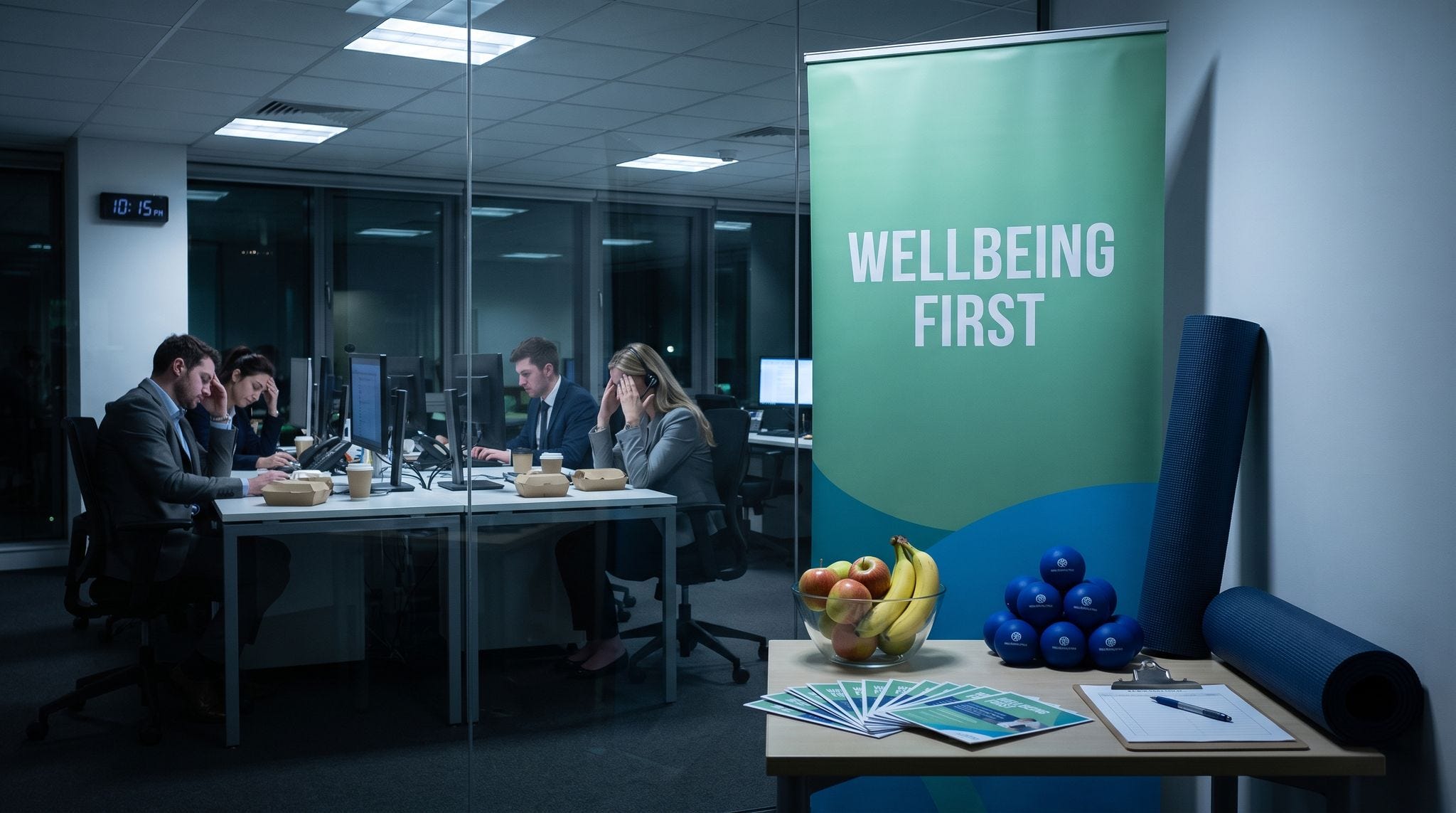
The first piece in a three-part Conviction series on the three jurisdictions of health: sovereign, national, global. Starting with the body.
Sovereign Health
Most corporate wellness programmes are not designed to make anybody well. They are designed to give the leader who commissioned them somewhere to point when the question of why their workforce is exhausted comes up.
That is not a cynical reading. It is the operating function. The gym membership, the meditation app, the wellness portal, the Employee Assistance Programme number on the back of the lanyard. Each of them, useful in isolation. All of them together, when deployed as a programme, doing one job above any other. Letting the leader avoid the diagnostic conversation about why their people are tired, burning out, taking sick days they did not take twelve months ago, and looking at the door.
There are three jurisdictions of health. Sovereign. National. Global. The order is not decorative. It tells you which jurisdiction is actually upstream of the others, and most of the public conversation about health currently runs the wrong way.
Sovereign first. The body you live in. The only jurisdiction nobody else can occupy.
The leader who has outsourced their team's wellness to a programme has, almost without exception, outsourced their own. Same posture. Same evasion. The personal and the institutional are the same move, viewed from two sides of the same desk.
The programme is the alibi
Four out of five large US employers now run a workplace wellness programme. The architecture is so embedded that its absence would look like negligence. The numbers on its effectiveness are an embarrassment.
The cleanest available test is the Song and Baicker randomised controlled trial published in JAMA in 2019. BJ's Wholesale Club, 32,974 employees, eighteen months, randomised at the worksite level to remove the self-selection bias that ruins most observational wellness research. The headline finding: some self-reported behavioural change, mostly around exercise awareness and weight management, and no measurable improvement in physical health outcomes. No movement in cholesterol. No movement in blood pressure. No movement in BMI. No movement in any of the biometric markers the programme was sold to move. No reduction in healthcare spending. No reduction in absenteeism.
A controlled trial of a real wellness programme, run by an experienced vendor, over eighteen months, across nearly thirty-three thousand workers, produced no measurable change in any of the things the programme was sold to change. People filled in surveys. They said they were paying more attention. The numbers did not move.
The industry has not stopped expanding since.
That is not a science problem. That is a leadership problem. And the problem is not that the programme failed to deliver what it promised. The problem is that the programme was never the answer to the actual question.
The actual question is the one the leader has been avoiding. Why is the workforce in this state? What is the operating model doing to the people inside it? Which roles are structurally untenable as currently designed? Which managers are running their teams into the ground and being rewarded for the short-term output? What does the calendar look like for a senior person on a typical Wednesday? What does the inbox look like at ten o'clock at night?
That conversation is hard, specific, and politically expensive inside an organisation. The wellness programme is none of those things. It is easy, generic, and politically free. The procurement cycle takes a quarter. The vendor produces a dashboard. The board paper writes itself. The leader can point to the programme the next time the question of employee wellbeing is raised, and the question moves on without ever being answered.
That is the operating function. Not health. Cover your ass.
The same move, in your own body
The leader who runs that move on their workforce is, almost without exception, running the same move on themselves.
The personal version looks slightly different but the mechanism is identical. The wearable on the wrist. The standing desk at home. The thirty-minute Peloton on Sunday morning. The executive health check that gets booked and not attended. The cardiologist's recommendation that was filed and never followed up. The diet that gets renewed every January and abandoned by March. Each of them, useful in isolation. All of them together, doing one job above any other. Letting the leader avoid the diagnostic conversation about why their own body is in the state it is in.
Why am I tired by Wednesday? Why have I gained eight kilograms in two years? Why is my sleep broken at three in the morning? Why am I drinking more than I did a decade ago? Why does the thought of my Monday produce the physical response in my body that it does? What am I running that produces this?
The leader who will not ask those questions about their own body has no standing to ask them about anybody else's. The People dimension of the 6Ps Code that sits inside Total QX™ starts with the operator, not the workforce. A leader who has not done the work of governing their own body has not earned the standing to organise anyone else's. The framework folds back on the holder before it ever reaches the team.
I write this as someone who has, over decades, built a working relationship with my own body that runs in parallel to whatever the system happens to be recommending this year. That relationship is what gives me the standing to ask the second-order questions when an intervention is proposed. Not because the intervention is wrong by default. Because the intervention has to pass through me, and I am the only person who can pass it through with the necessary attention.
The captured science
One specific case clarifies what is at stake. Cholesterol.
The human brain is the body's most cholesterol-rich organ. Roughly twenty-five per cent of the body's total cholesterol sits in the brain, despite the brain accounting for only about two per cent of body mass. Cholesterol is structural to the membranes of every nerve cell. Myelin, the insulation around nerve fibres that allows them to fire, is mostly cholesterol. Synapses depend on it. None of that is contested.
The widespread modern prescription for elevated cholesterol is a statin. Statins reduce the body's cholesterol production systemically. Some statins are lipophilic, which means they cross the blood-brain barrier and reduce cholesterol production inside the brain itself. The two most prescribed lipophilic statins are simvastatin and atorvastatin.
Whether reducing cholesterol production inside the brain is net protective or net harmful for cognitive outcomes is, in the published literature, contested. There is research suggesting protective effects, generally attributed to vascular and anti-inflammatory mechanisms. There is research suggesting harm, including a 2021 study in patients with cognitive impairment showing that lipophilic statin users had more than twice the rate of progression to dementia over eight years compared to non-users. The mechanistic question is open. The clinical question is open.
The guidance that reaches the patient, and the GP, and the wellness programme nurse, does not present the question as open. It presents the answer as settled. Reduce cholesterol. Take the statin. Repeat the test in twelve weeks. The contested literature does not reach the consultation room.
Same operator, two standards. The leader who would not accept a board paper without knowing who paid for it, who funded the analysis, what assumptions were baked in, will take a prescription with none of those questions asked. The standard at work is forensic. The standard in the doctor's office is compliance.
Apply the same operator-grade due diligence to the things being done to your body that you apply to the things being done to your company. What is the proposed intervention? What are the alternatives? What is the evidence for each? What happens if I decline? What is the time horizon over which the harms and benefits show up? Whose work, whose funding, whose career, sits behind the recommendation?
If the answers are evasive, the intervention has not earned consent. If the answers are clean, consent given on that basis is sovereign consent. Different transaction entirely.
What 'alternative' is for
The capture runs in language as well as in science, and the word that gives the game away is 'alternative'.
'Alternative' in English used to mean a different option. One choice rather than another. Two roads. Take your pick. In modern health vocabulary, when applied to medicine, the word does something else entirely. It downgrades. Alternative medicine. Alternative practitioner. Alternative therapy. The default is the pharmaceutical-surgical model. Everything outside it is the alternative. The implication is fringe, unproven, suspect, lesser.
The same operation has been run on 'conservative management.' Conservative used to mean prudent. First, careful, restrained. In current medical usage, conservative management is coded as the second-rate option for the patient who is refusing the real treatment. The meaning of the word has been inverted.
The framing protects the default. What gets ruled out by the framing is whatever is most likely to be cheap, drug-free, slow, and impossible to monetise inside the captured architecture. Eating real food. Sleeping enough. Exposure to morning sun. Intermittent fasting. Meditation. Walking. Lifting heavy things. The removal of seed oils, refined sugar, and ultra-processed inputs from the diet. The removal of late-night artificial light. The removal of low-grade chronic stress that the operating model is generating. The removal of the substances that get pulled out of the cabinet at six o'clock every night to take the edge off the day the operating model produced.
None of these is fringe. All are older than the pharmaceutical default by centuries or millennia. They are the protocol the default replaced. They were also, until recently, what an honest GP would have run a patient through before reaching for the prescription pad.
I am not a doctor. None of this is medical advice. What it is, is a refusal to accept the language that was built to make a person feel embarrassed for asking about any of these approaches in a consultation room. The embarrassment is engineered. It is part of the architecture. Once the engineering is visible, the embarrassment loses most of its grip.
The structural causes of modern unhealth are not mysterious. The food supply has been industrialised. The work day is sedentary, lit by screens, and bracketed by commutes that displace sleep on both ends. The diet is dominated by inputs the human body did not evolve to process. The chronic stress is unrelenting and treated as a fixed condition rather than a variable. The body, given the conditions it was designed for, in most cases knows what to do. The conditions are what have been removed. Restoring the conditions, in whatever portion is within reach, is the work that does not require permission.
What changes when the layer is held
A leader who holds the sovereign layer does three things differently. None of them is dramatic. All of them compound.
First, they audit themselves at the same cadence they audit their company. Whatever quarterly rhythm they use to interrogate the business is the rhythm they use to interrogate the body. Not a checklist. A conversation with themselves and whatever clinical inputs they have chosen to trust. They know what their body is doing this quarter the way they know what their P&L is doing this quarter. Same standing relationship. Same accountability.
Second, they stop accepting interventions on themselves they would not accept on the business. Every recommendation gets the operator's interrogation before it gets the patient's consent. The recommendation either holds up or it does not. When it holds, the consent given is real. When it does not, the alternative is not nothing. The alternative is the older protocol. Food. Sleep. Movement. Light. Stress removal. Time. The conditions the body was built for, restored in whatever portion the operator can restore them.
Third, and this is the one that changes everything else, they bring the same diagnostic posture back to the team. The wellness programme stays or goes on its own merits, but it is no longer the alibi. The question of why people are unwell becomes a real question with an honest answer. The operating model gets interrogated. The roles that produce burnout get redesigned or eliminated. The managers running teams into the ground get held to account or moved out. The calendar discipline starts at the top, because that is the only place it can credibly start.
That is what sovereign health, held by a leader, actually changes. Not the leader's biometrics. The standard the leader is willing to apply to the operating environment they own.
The refusal that holds
Either you have audited your own body this quarter or you have not. Either you have asked who paid for the recommendation in your prescription or you have not. Either you have looked honestly at what your operating model is doing to the people inside it, or you have made the wellness programme do the looking for you.
The defaults are not neutral. The defaults were engineered. Each one, in isolation, looks like convenience. The accumulated weight is what is now showing up in the workforce, in the leader's body, and in the standards the leader has stopped being able to enforce.
The architecture does not need to take the body from you. It just needs you to keep handing it over, one default at a time. Most leaders do. The ones who do not are the ones whose authority still carries when it counts.
Decide which one you are.

Paul Lange advises owners, executives, and boards on the decisions that define commercial outcomes and organisational character, and on what a working board actually contributes. He has spent close to four decades across finance, technology, hospitality, professional services, and operating roles, in Europe, Asia, the Middle East, and Australia, on both sides of the table, with private equity and venture capital one part of it, and has taken five of his own companies through to exit. He is the creator of the Total QX™ and TILE Theory™ frameworks, and the author of The 20% Leader, Mis(très)s Entrepreneur Manifesto, Evolve or Be Remembered, and The Inheritance Manifesto. He runs his advisory practice, Manolutions, from the Gold Coast, Queensland. He writes Conviction because leadership without accountability is just theatre.