
Normalisation → Ownership

This is the fifth in a six-part series mapping a KGB defector's blueprint for collapsing a nation onto the way organisations are hollowed out by their own leadership. The stages compound. To see how this one fits, start with The Bezmenov Blueprint.
The most dangerous sentence in any organisation is seven words long.
"That's just how we do it here."
It is never shouted. It is never written in a memo. It is never challenged in a meeting because the people saying it have already stopped believing that challenging anything will produce a result. It is the verbal signature of an organisation that has completed the full Bezmenov sequence and arrived at normalisation without anyone noticing the journey.
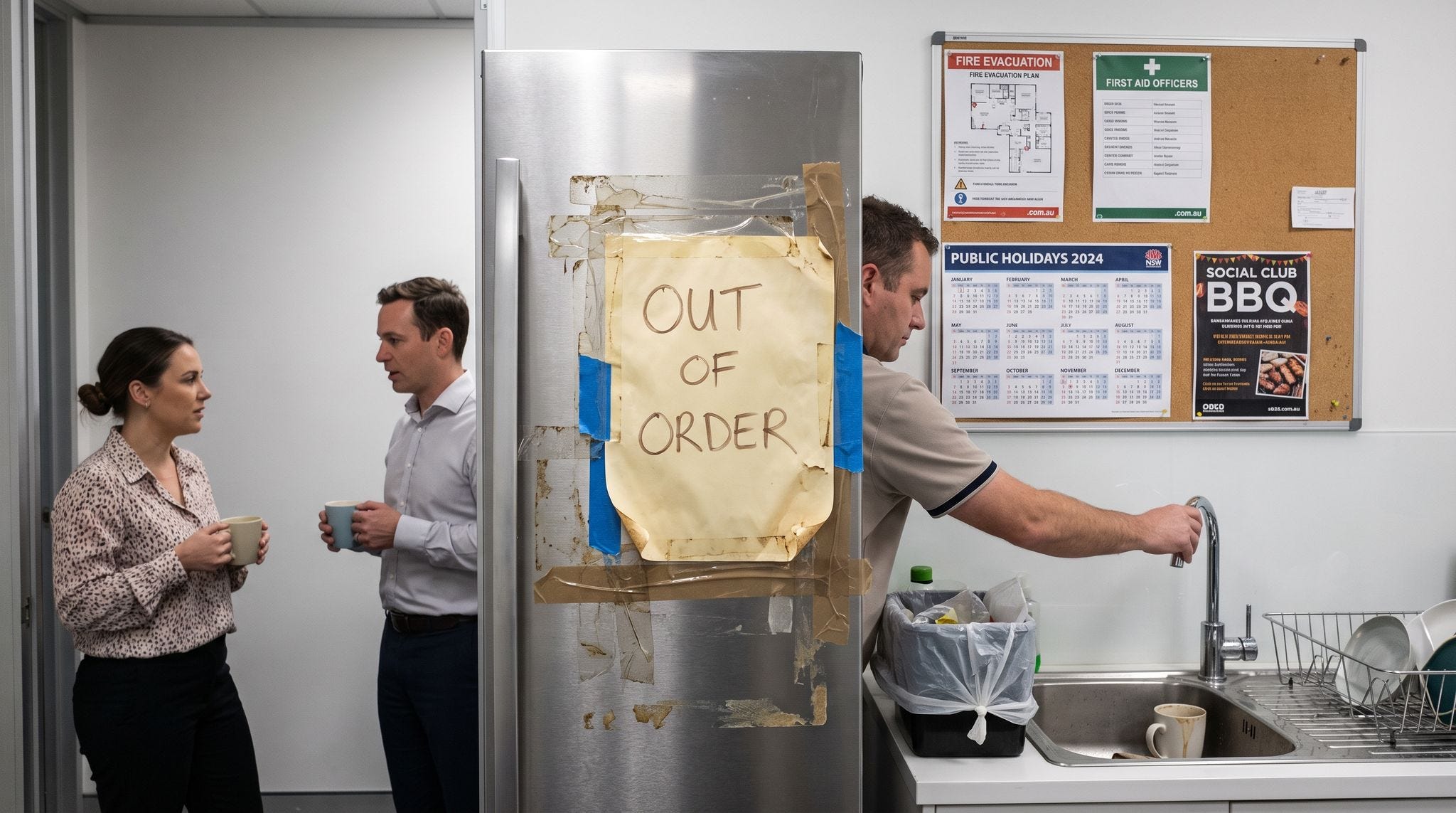
Demoralisation eroded belief. Destabilisation dismantled the structures. Crisis forced the reckoning. And now, in the aftermath, the organisation has settled into a diminished version of itself and accepted it as the permanent condition. Not with a vote. Not with a formal decision. With a shrug.
That shrug is normalisation. And it is the most dangerous stage because it feels like stability.
The Counterfeit Peace
In Bezmenov's model, normalisation was the final stage. The one that locked everything in. After the crisis passed and the new terms were imposed, the population accepted them. Not because the new reality was good. Not because anyone agreed to it. Because resistance felt pointless, the memory of what existed before had faded, and the new conditions had been in place long enough to feel permanent.
Bezmenov was precise about the psychology of this stage. Normalisation does not require people to be happy. It requires them to be resigned. The distinction matters. Happy people invest in the future. Resigned people protect what they have left. Happy people challenge poor decisions because they believe better outcomes are possible. Resigned people let poor decisions stand because they have stopped believing their input changes anything.
Inside organisations, normalisation has a specific texture. You can feel it in the room even when nobody names it.
It is the meeting where everyone knows the strategy is failing but nobody raises it because the last three people who raised concerns were sidelined. It is the hiring process that produces the same mediocre outcome repeatedly because the standards were lowered so gradually that nobody remembers what the original bar looked like. It is the annual review cycle that exists to justify decisions already made rather than to evaluate performance honestly. It is the quiet departure of ambitious people who have concluded that the organisation will not change, followed by the collective agreement among those who remain that the people who left "were not the right fit."
The most corrosive feature of normalisation is that it generates its own evidence. Once the best people leave, the remaining performance becomes the benchmark. Once standards drop, the lower output becomes the expectation. Once mediocrity is tolerated long enough, it is indistinguishable from the operating standard. Anyone who arrives from outside and questions it is treated as naive or unrealistic. "You don't understand how things work here" is normalisation defending itself.
Bezmenov understood that this was the hardest stage to reverse. Not because it is enforced with force, but because it is enforced with familiarity. People will fight an obvious oppressor. They will rarely fight a reality they have come to accept as inevitable.
The Difference Between Compliance and Ownership
There is a version of organisational recovery that looks like it reverses normalisation but does not. It is the version that imposes new standards from the top, installs new processes, rolls out a new strategy, and demands compliance.
Compliance will produce a short-term improvement. It always does. People adjust their behaviour to meet the new requirement because the new requirement has consequences. But compliance without ownership is a holding pattern. The moment the pressure eases, the moment leadership attention shifts, the moment the quarterly review cycle moves on, the organisation drifts back to its prior state. Not because people are disobedient. Because they never owned the new standard. They performed it. There is a difference.
There is a worse outcome than drift. The imposed structure itself becomes the new normal. The compliance framework calcifies. Nobody chose it. Nobody agreed to it. But it has been in place long enough that questioning it feels like questioning gravity. What began as a temporary response to pressure becomes the permanent operating standard that nobody examines because examining it would require admitting it was never the right answer in the first place. That is not recovery. That is normalisation wearing a management badge.
The difference between both failure modes and genuine recovery is agency.
Compliance is external. Someone tells you what the standard is. You meet it because the consequences of not meeting it are immediate and visible. Your behaviour changes. Your investment does not.
Ownership is internal. You know what the standard is because you helped build it. You meet it because you understand why it matters, not just what it costs to violate it. Your behaviour changes because your relationship to the work has changed. The standard is not imposed on you. It belongs to you.
Organisations built on compliance require constant supervision. The standard holds only as long as someone is watching. Organisations built on ownership are self-sustaining. The standard holds because the people inside it have a stake in its survival.
That is the distinction Bezmenov's framework makes visible. Normalisation produces compliance at best. People go through the motions because the motions are all that remain. Ownership produces something normalisation cannot touch: people who actively sustain and evolve the standard because they built it.
Building Ownership, Not Announcing It
Ownership is not a speech. It is not a values offsite. It is not a poster on the wall or a slide in the all-hands deck. Every leader who has tried to install ownership by announcement has discovered the same thing: the announcement produces a brief uptick in engagement metrics and no lasting change in behaviour.
Ownership is built. Deliberately. One standard at a time. And it follows a sequence that is as structured as the Bezmenov model it inverts.
The methodology I developed for this is called Built To Own™. It moves through five stages, each one building on the last, each one producing a specific, tangible output that did not exist before.
It starts with seeing what you are still carrying. Before ownership can be transferred, the leader has to name what they are holding that does not belong to them. The decisions that escalate unnecessarily. The problems that keep returning because they were never truly handed off. The weight that the leader carries not because they must, but because it was never made explicit that someone else should. Most leaders are surprised by this audit. Not because they did not know they were carrying too much, but because they had not mapped exactly where the ownership gaps were.
It moves to defining what great actually looks like. Not in abstract terms. In written, specific, operational terms that someone can act on tomorrow without asking the leader a question. The single most common failure in organisations is the assumption that standards are shared when they have never been articulated. What leaders call "common sense" is almost always private interpretation. Until the standard is written, it is a wish.
It builds the conversation that installs the standard. Not a performance review. Not a feedback session. A direct, specific ownership conversation with a real person about a real gap. Most leaders avoid this conversation for months or years, substituting hints, re-explanations, and workarounds for the direct statement that something needs to change. The conversation is not difficult. It is just direct. And most leadership cultures have forgotten what direct actually sounds like.
It locks a 30-day move. Not a transformation programme. Not a strategic initiative. One specific, executable action with a named person, a committed date, and a clear definition of what success looks like at day 30\. The move is deliberately small because small moves that actually happen compound faster than ambitious plans that never start.
And it cements a reinforcement rhythm. A weekly cadence that keeps the standard visible and the ownership accountable. Without rhythm, standards decay. Every leader who has installed a new expectation and watched it erode within six weeks knows this. The expectation did not fail. The reinforcement did.
Spot it. Shift it. Script it. Sprint it. Stick it. Five stages. Each one produces something the leader can hold in their hand and use the following morning. Not theory. Not inspiration. Structure that builds ownership into the operating rhythm of the business.
The Ownership Test
The diagnostic question for this article mirrors the one posed for crisis, but it reaches deeper.
If you stepped away from your organisation for 90 days, would the standards hold, improve, or decay?
Not the output. Not the revenue. The standards. The quality of decision-making. The way people treat each other and the work. The things that define whether the organisation is operating at the level it claims to operate at, or whether it is quietly sliding toward the mean.
If the honest answer is that the standards would decay, then what you have is not ownership. It is dependency dressed as delegation. The organisation is not running on standards. It is running on you. And that is not a business. It is a bottleneck with a logo.
The difference between organisations people endure and organisations people own is not morale. It is not engagement. It is not culture in the abstract sense that HR departments measure with annual surveys. It is whether the people inside the organisation have a genuine stake in the standard, a genuine role in sustaining it, and a genuine belief that their contribution matters.
Normalisation kills all three. Ownership builds all three. And the transition from one to the other is not inspirational. It is mechanical. It is built one standard at a time, one conversation at a time, one 30-day move at a time, until the organisation no longer needs the leader to hold it together because the standard holds it together instead.
That is what Built To Own™ does. Not because the methodology is clever. Because ownership is not a mystery. It is a sequence that most leaders have never been taught to follow.
If everything escalates to you, you do not own an asset. You own a job. And the only way to change that is to build something your team owns as deeply as you do.
That build starts with one standard. This week.
Next in the series: The Full Inversion. With all four stages examined, what does the complete picture look like, and which playbook are you running?
Paul Lange advises owners, executives, and boards on the decisions that define commercial outcomes and organisational character, and on what a working board actually contributes. He has spent close to four decades across finance, technology, hospitality, professional services, and operating roles, in Europe, Asia, the Middle East, and Australia, on both sides of the table, with private equity and venture capital one part of it, and has taken five of his own companies through to exit. He is the creator of the Total QX™ and TILE Theory™ frameworks, and the author of The 20% Leader, Mis(très)s Entrepreneur Manifesto, Evolve or Be Remembered, and The Inheritance Manifesto. He runs his advisory practice, Manolutions, from the Gold Coast, Queensland. He writes Conviction because leadership without accountability is just theatre.